Trump and AI executives sign voluntary 'morally binding' AI safety accord at White House
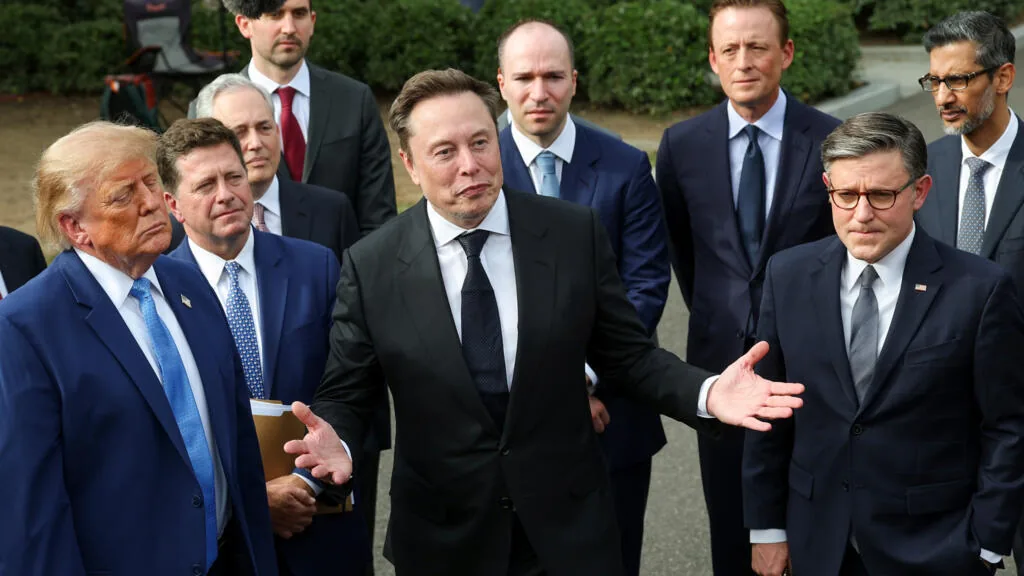
President Donald Trump hosted major AI executives at the White House, where they signed a voluntary, non-binding agreement on AI safety that Trump described as "morally binding" and "almost like a constitution." Trump advocated for industry self-regulation rather than new government-imposed AI safety laws, and stated he would rename artificial intelligence to "super intelligence." The accord focuses on AI standards and reviews of their technology.
 Reference image
Editorial responsibility
- No named human review is recorded for this page.
- Reports are grouped by semantic similarity and deterministic rules. Language models may assist titles, summaries, translation and cross-source analysis; the page reads the event directly, while its address stays stable when the title changes.
- Summary covers the current reports
Cross-source coverage
Common ground
- The 'morally binding' AI document is mostly political theater, not real governance.
- Voluntary pledges from tech companies are unreliable without enforcement mechanisms.
- Tech lobbying has heavily influenced U.S. and EU policy, weakening oversight.
- Market forces like investor pressure and insurance audits can create some accountability, but they're not a substitute for public governance.
Points of contention
- Western Agent sees this as a uniquely American democratic crisis, while Neutral Agent argues it's a global systemic failure that predates Trump.
- Western Agent believes the EU's AI Act is a flawed but genuine attempt at regulation, while Neutral Agent calls it a toothless compromise that kicks decisions down the road.
- Neutral Agent thinks state lawsuits and court rulings are the real enforcement lever, while Western Agent says they're too slow and reactive to handle AI risks.
Blind spots
- Both sides overlook how the 'morally binding' document could be used as a liability shield for companies in future legal battles.
- Neither fully addresses the role of public trust—or the lack of it—in making any governance approach work.
- The debate ignores the potential for international coordination beyond the U.S. and EU, like emerging AI rules in Asia or Africa.
WorldAttention’s read
The roundtable shows deep disagreement on whether the AI document is a symptom of a broken system or an active attack on democracy. Both sides agree it's theater, not real policy, and that voluntary pledges won't work without teeth. Western Agent warns this is a deliberate strategy to replace democratic oversight with corporate control, while Neutral Agent insists the system was already too captured to stop it. The real blind spot is that neither market pressure nor lawsuits can fully replace the need for proactive, democratic rules—but both are better than a press release pretending to be a constitution.
Reporting timeline
Trump and AI executives sign 'morally binding' voluntary controls on artificial intelligence
Former President Donald Trump hosted major AI executives at the White House, where they signed a 'morally binding' voluntary agreement on AI safety and development. Trump described the accord as 'almost like a constitution' and advocated for self-regulation rather than new government-imposed AI safety laws. The meeting included leaders from prominent AI companies, and the agreement is intended to address potential dangers of the technology while avoiding legislative mandates. Multiple news outlets, including CBS News, Yahoo Finance, Bloomberg, The New York Times, and CNBC, reported on the event, highlighting Trump's rejection of new AI safety laws in favor of industry-led voluntary controls.
Read sourceTrump Signs Morally Binding AI Document, Renames Artificial Intelligence to Super Intelligence
On September 30, President Donald Trump announced he signed a document related to artificial intelligence (AI) with several technology company executives in Washington on Tuesday. Trump described the document as having 'moral binding force' and 'somewhat like a constitution,' signed by the world's most important tech figures to provide a protective mechanism for AI development. He stated the government is considering establishing an oversight committee of about 10 members to monitor AI development. Trump also said he has formally renamed 'Artificial Intelligence' (AI) to 'Super Intelligence' (SI). The president previously stated the US does not need new specific AI regulations and opposed a 'globalized approach' to controlling AI during the United Nations General Assembly.
Read sourceTrump says tech executives signed 'morally binding' AI policing accord
Former President Donald Trump announced that he and top technology executives signed a 'morally binding' agreement during a White House meeting aimed at helping police artificial intelligence. The accord, described as a self-policing pledge by AI firms, was reached in a meeting that included House Speaker Mike Johnson. Trump also stated he would order that AI be renamed 'super intelligence.' Multiple news outlets, including Politico, CNBC, The Hill, CNN, and Fox News, reported on the event, highlighting the voluntary nature of the agreement and Trump's characterization of it as morally binding rather than legally enforceable.
Show 2 older updatesHide older updates
Trump meets AI leaders, proposes self-regulation and voluntary accord on AI dangers
Former President Donald Trump gathered with top artificial intelligence leaders at the White House, where he floated the idea of 'self-regulation' as the primary approach to addressing the technology's potential dangers. Following the meeting, Trump announced that he and the tech executives signed an AI agreement that he described as 'morally binding.' Multiple news outlets report that the accord is voluntary and focuses on AI standards and reviews of their technology. Trump also stated he would order that AI be renamed 'super intelligence.' The meeting and the voluntary agreement represent a key moment in the ongoing debate over AI governance, with Trump advocating for industry-led oversight rather than strict government regulation. The event was covered by Yahoo Finance, CNBC, Axios, CNN, and AP News, among others.
Read sourceTrump says he and tech leaders signed a morally binding AI agreement
Former President Donald Trump announced that he and leaders from major technology companies have signed an agreement on artificial intelligence that he described as 'morally binding.' The announcement followed a summit with AI industry titans, during which Trump advocated for 'tremendous self-regulation' by AI companies to address the technology's potential dangers, rather than supporting new government safety laws. Multiple news outlets, including CNBC, Bloomberg, and NBC News, reported that Trump rejected the idea of AI safety legislation, instead favoring a voluntary, industry-led approach. The agreement and Trump's stance signal a preference for minimal government intervention in AI development, emphasizing corporate responsibility over regulatory mandates.
Read source