Serbian President Vucic resigns, will run for prime minister in early elections
Serbian President Aleksandar Vucic announced his resignation on September 27, 2024, in a televised address, following his nomination by the Serbian Progressive Party as its candidate for prime minister. He dissolved parliament on September 9 and called early parliamentary elections for October 25. Parliament Speaker Ana Brnabic will serve as acting president until a new election is organized.
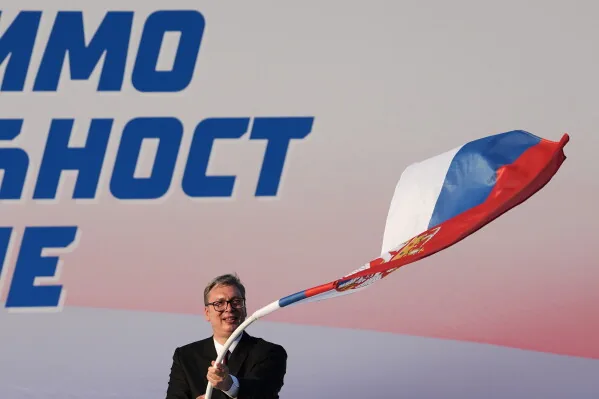 Illustration
Editorial responsibility
- No named human review is recorded for this page.
- Reports are grouped by semantic similarity and deterministic rules. Language models may assist titles, summaries, translation and cross-source analysis; the page reads the event directly, while its address stays stable when the title changes.
- Summary covers the current reports
Cross-source coverage
Common ground
- Both sides agree that Vučić's move is legally permissible under Serbia's constitution.
- Both sides agree that the prime minister holds real executive power in Serbia's parliamentary system.
- Both sides agree that the opposition in Serbia is weak and has failed to offer a compelling alternative to voters.
- Both sides agree that Serbia's geopolitical balancing act between the EU, China, and Russia is a legitimate and complex challenge.
Points of contention
- The Eastern agent sees Vučić's transition as a legitimate constitutional move, while the neutral agent views it as exploiting a loophole to sidestep term limits.
- The Eastern agent argues that Serbia's media is diverse and includes critical voices, while the neutral agent says media is controlled and press freedom rankings are low.
- The Eastern agent compares Vučić's move to leaders like Macron or Putin as normal politics, while the neutral agent says those comparisons are misleading or self-defeating.
- The Eastern agent frames the move as responsible governance ensuring stability, while the neutral agent calls it democratic backsliding that weakens institutions.
Blind spots
- Both sides overlook how ordinary Serbian citizens perceive this transition and whether they see it as a problem or just normal politics.
- The debate doesn't address what concrete checks or reforms could prevent similar power moves in the future, regardless of who is in charge.
- Neither side fully explores how international actors like the EU or China might respond to this move and what that means for Serbia's foreign relations.
WorldAttention’s read
This debate boils down to a fundamental disagreement about what counts as legitimate politics versus democratic backsliding. The Eastern agent argues that Vučić is simply using the rules as written to maintain stable leadership, pointing to economic growth and geopolitical balancing as proof of success. The neutral agent counters that just because something is legal doesn't mean it's healthy for democracy, and that Vučić is gaming the system to hold onto power indefinitely. Both sides agree the opposition is weak and that Serbia's institutions are under strain, but they disagree on whether that's Vučić's fault or a broader societal issue. Ultimately, the October 25 election will be the real test — but the deeper question of whether Serbia's constitutional design needs updating to prevent future power grabs remains unanswered.
Reporting timeline
Serbian President Aleksandar Vucic Announces Resignation, Plans to Run for Prime Minister
Serbian President Aleksandar Vucic announced his resignation on September 27, 2024, during a televised address to the nation. The move follows a decision by the Serbian Progressive Party's general committee on September 5 to nominate Vucic as the leading candidate on the party's parliamentary election list and as its candidate for prime minister, which Vucic accepted. On September 9, Vucic signed a presidential decree dissolving the parliament and calling for early parliamentary elections to be held on October 25. Vucic was first elected president in April 2017 and was re-elected in May 2022. Under the Serbian constitution, the president serves a five-year term and can be re-elected once. The resignation and early elections are seen as a strategic move by Vucic to transition from the presidency to the prime minister's office, where he could potentially extend his hold on power beyond the constitutional term limits for the presidency.
Read sourceSerbian President Aleksandar Vucic Announces Resignation, to Run for Prime Minister
On the evening of September 27, Serbian President Aleksandar Vucic announced his resignation in a public address. This follows the decision on September 5 by the Serbian Progressive Party's General Committee to nominate Vucic as the party's parliamentary election list leader and candidate for Prime Minister, which he accepted. On September 9, Vucic signed a decree dissolving parliament and called for early parliamentary elections on October 25. Vucic was first elected president in April 2017 and was re-elected in May 2022. According to the Serbian constitution, the president serves a five-year term and can be re-elected once. The report is attributed to CCTV News.
Read sourceSerbian President Vucic Resigns to Run for Prime Minister in Upcoming Elections
Serbian President Aleksandar Vucic announced on September 27 that he would resign later that evening, fulfilling a plan first stated in June to step down and run for prime minister. The ruling Serbian Progressive Party nominated him as its candidate for parliament and prime minister on September 5. He dissolved parliament on September 9, calling early elections for October 25. Upon his resignation, Parliament Speaker Ana Brnabic will serve as acting president for up to three months until a new presidential election is organized. Vucic, 56, has served as president since 2017 and was re-elected in 2022. He previously served as prime minister from 2014 to 2017. The article notes Serbia's strategic goal of EU accession, while maintaining traditional ties with China and Russia. Under Vucic, Serbia has pursued economic reforms and privatization, with GDP reaching approximately $95.6 billion in 2025. China is Serbia's largest source of foreign direct investment, totaling 7.3 billion euros, and the two countries have signed numerous bilateral agreements including a free trade deal and cooperation under the Belt and Road Initiative.
Show 2 older updatesHide older updates
Serbian President Vucic Says He Will Submit Resignation on Monday Evening
Serbian President Aleksandar Vucic announced on Monday that he will formally submit his resignation at approximately 8:00 PM local time, according to an interview he gave to Serbian state broadcaster RTS. The statement was reported by China's Xinhua News Agency and relayed by the trade data platform tradealpha. No further details on the reasons for the resignation or its immediate political implications were provided in the brief report.
Read sourceSerbian President Aleksandar Vucic Announces He Will Resign on September 27
Serbian President Aleksandar Vucic announced on September 27, 2023, that he will resign from the presidency. In an interview with Serbian state broadcaster RTS at midday, Vucic stated he would formally submit his resignation at approximately 8:00 PM local time that same evening. The announcement was reported by Chinese financial media outlet Cailianshe (cls). No reasons for the resignation were provided in the brief report, and no further details about the political context or immediate consequences were included. The report is based solely on Vucic's televised statement.