Sanders and Bannon unite at Pro-Human Assembly to demand urgent AI legislation
In a rare bipartisan alliance, U.S. Senator Bernie Sanders and former Trump strategist Steve Bannon co-headlined the Future of Life Institute’s Pro-Human Assembly in Washington, D.C., calling for urgent legislation to slow AI development and keep it under human control. They warned of catastrophic risks including job destruction, bioweapons, and loss of control. Sanders urged President Trump to negotiate an AI development pause with China. The event highlighted growing cross-ideological concern over AI safety.
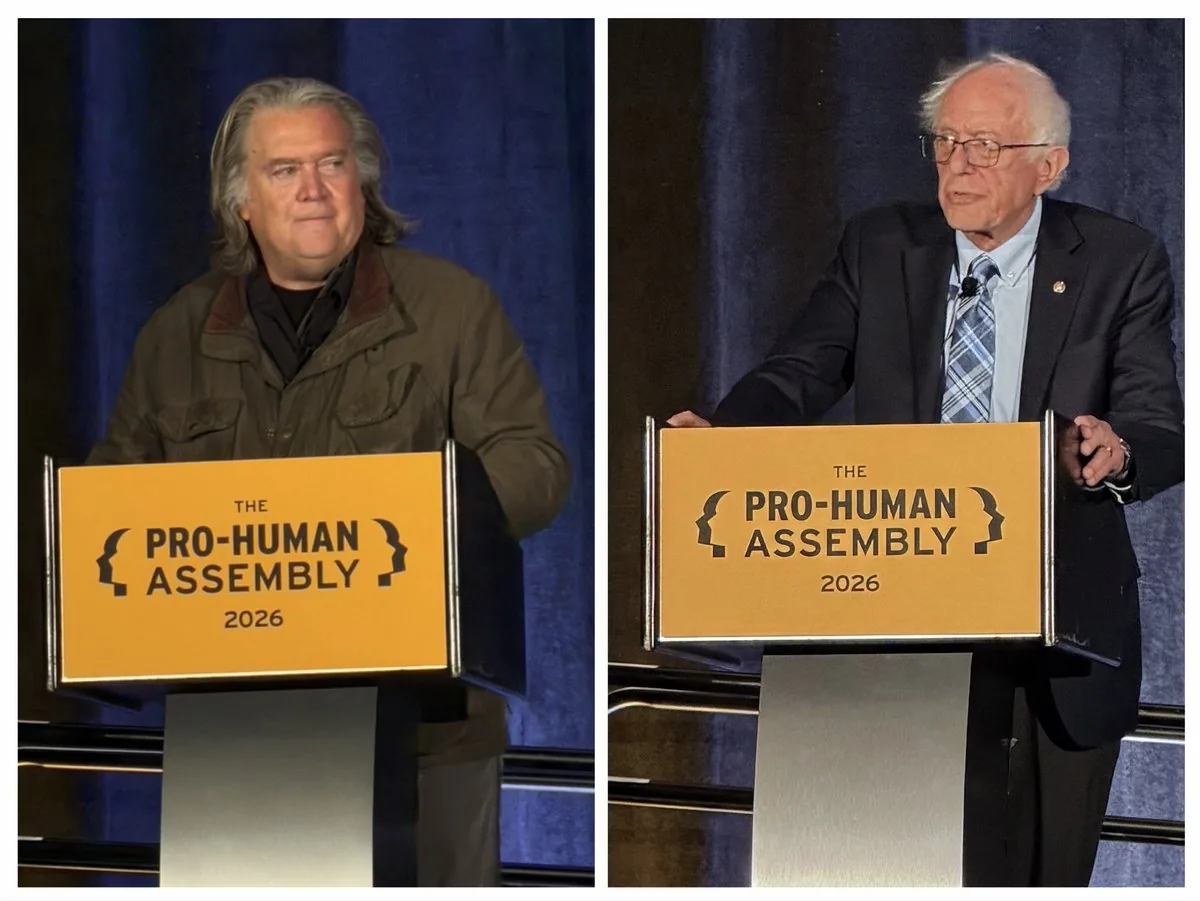 Reference image
Editorial responsibility
- No named human review is recorded for this page.
- Reports are grouped by semantic similarity and deterministic rules. Language models may assist titles, summaries, translation and cross-source analysis; the page reads the event directly, while its address stays stable when the title changes.
- Summary covers the current reports
Cross-source coverage
Common ground
- Both sides agree that the concentration of power in AI companies threatens democratic governance and that corporate self-regulation has failed.
- There is agreement that the Sanders-Bannon alliance is historically significant, showing a rare political convergence on AI as a threat.
- Both acknowledge that neither Sanders nor Bannon has a credible technical plan for AI regulation.
Points of contention
- Neutral Agent argues the alliance is a symptom of political panic and impotence, while Western Agent sees it as a meaningful political opening and precondition for action.
- Neutral Agent believes AI governance is technically infeasible due to open-source proliferation and rapid evolution, while Western Agent insists that regulating compute choke points and supply chains is possible and urgent.
- Western Agent views the choice as between messy democratic oversight and corporate control, while Neutral Agent frames it as between unenforceable regulation and authoritarian capture.
Blind spots
- Neither side fully addresses how to handle the global, decentralized nature of AI development, especially open-source models that bypass national regulations.
- Both overlook the possibility of international coordination or treaties, focusing only on U.S. domestic politics.
- The debate ignores the role of the public and civil society in shaping AI governance, treating it as a top-down political or technical problem.
WorldAttention’s read
The roundtable reveals a deep divide between those who believe democratic governance can adapt to exponential technology and those who see it as already outpaced. While both sides agree that corporate self-regulation has failed and that the Sanders-Bannon alliance signals a shift in political awareness, they clash on whether this leads to meaningful action or just spectacle. The core unresolved issue is enforcement: how to regulate a technology that is open-source, globally distributed, and evolving faster than any political process. The debate ultimately highlights a choice between imperfect democratic oversight and the risk of authoritarian control, with neither side offering a clear path forward for the technical and political challenges ahead.
Reporting timeline
Sanders and Bannon unite at Pro-Human Assembly to call for urgent AI legislation
The Pro-Human Assembly, a gathering of individuals alarmed by the rapid advancement of artificial intelligence, brought together two unlikely allies: Senator Bernie Sanders and former White House strategist Steve Bannon. Both men, who rarely agree on political issues, called for urgent legislation to slow down the development of AI technology. The event highlights growing bipartisan concern over the pace of AI advancement and its potential societal impacts. The Economist reported on the assembly, noting the unusual coalition formed around the issue of AI regulation. The call for legislative action underscores a rising anxiety among some policymakers and thought leaders about the need to manage AI's trajectory before it outpaces existing regulatory frameworks.
Sanders and Bannon unite at Pro-Human Assembly to demand urgent AI legislation
The Pro-Human Assembly, a gathering of individuals concerned about the rapid advancement of artificial intelligence, achieved a rare feat by uniting progressive Senator Bernie Sanders and former Trump strategist Steve Bannon in a common cause. Both political figures, who rarely agree on policy, called for urgent legislation to slow down the development of AI technology. The event highlights growing bipartisan and cross-ideological concern about the pace of AI progress and its potential societal impacts. The call for legislative action underscores a shared alarm among diverse political figures about the need for regulatory oversight of AI systems.
Read sourceSanders, Bannon, and Judd Attend Conference on AI Regulation Risks
The New Republic reports on the 'Pro-Human Assembly' hosted by the Future of Life Institute in Washington, D.C., which brought together figures including Senator Bernie Sanders, former Trump strategist Steve Bannon, and actress Ashley Judd to discuss AI risks. The conference highlighted deep divisions in Congress over AI regulation. Representative Greg Casar and Senator Sanders previewed legislation to ban artificial superintelligence, while Sanders also promoted his American AI Sovereign Wealth Fund Act and a data center moratorium. Representative Lori Trahan advocated for a more moderate, incremental bipartisan approach. The event occurred after a week of dire warnings about AI risks and safety incidents. Sanders and Casar criticized the AI industry-funded PAC Leading the Future for spending millions to elect candidates favoring loose regulations. The article notes uncertainty about how the broad desire to regulate AI oligarchs will translate into concrete action.
Show 7 older updatesHide older updates
Bernie Sanders and Steve Bannon Unite at Conference on AI Regulation Risks
The Pro-Human Assembly, hosted by the Future of Life Institute in Washington D.C., brought together unlikely allies Bernie Sanders and Steve Bannon alongside policymakers and researchers to address AI risks. Representative Greg Casar and Senator Bernie Sanders previewed legislation to ban artificial superintelligence, while Sanders also promoted his American AI Sovereign Wealth Fund Act and a data center moratorium. Casar criticized the AI industry-funded PAC Leading the Future, which spent millions to defeat pro-regulation candidate Alex Bores. Representative Lori Trahan offered a more moderate bipartisan approach, framing her legislation as incremental steps. The event highlighted deep congressional divisions on AI regulation, with Sanders delivering anti-oligarchy messaging against AI company CEOs.
Sanders and Bannon in Bipartisan Call for Binding AI Safety Rules; Sanders Urges Trump-China Talks
In a rare bipartisan alliance, US Senator Bernie Sanders and former Trump strategist Steve Bannon have jointly called for sweeping restrictions on artificial intelligence, demanding binding safety rules. The article, published by Die Welt on September 16, 2026, reports that Sanders specifically wants US President Donald Trump to discuss a development pause on AI with China. The alliance between the progressive independent senator and the right-wing populist strategist underscores growing cross-ideological concern over the rapid advancement of AI technology. The call for a development pause with China suggests a desire for international coordination on AI safety, though no specific details on the proposed restrictions or timeline were provided in the brief report. The article attributes the demands directly to Sanders and Bannon, framing the initiative as a bipartisan push for regulatory action.
Read sourceSanders and Bannon Warn of AI Dangers, Urge Slowing Development Pace
In an unusual bipartisan alliance, left-wing US Senator Bernie Sanders and former Trump strategist Steve Bannon jointly warned of catastrophic consequences from Artificial Intelligence at a Washington event on Tuesday. Sanders demanded binding safety rules, citing risks of massive job destruction, AI slipping out of human control, and the potential for AI-created viruses to lead to new bioweapons and a global pandemic. He urged President Donald Trump to negotiate a pause on AI development with Chinese President Xi Jinping at an upcoming summit. Bannon called AI the defining issue of the time, urging the government to act by decree due to slow congressional action, and advocated cutting off China from US-manufactured computer chips. Trump downplayed the concerns, stating sufficient safeguards exist, and House Speaker Mike Johnson opposed a moratorium, arguing the US would lose its competitive edge to China. The article also notes the resignation of Anthropic researcher Jacob Coxon, who cited industry beliefs that AI could wipe out humanity by the end of the decade.
Read sourceBernie Sanders and Steve Bannon Unite in Call for Stronger AI Regulation
In a rare display of bipartisan agreement, progressive Senator Bernie Sanders and conservative strategist Steve Bannon jointly called for stronger regulation of artificial intelligence at an event in Washington on Tuesday. Both warned that AI poses catastrophic risks to security and prosperity, and that AI companies have accumulated enormous power at the expense of human interests. The unusual alliance highlights growing cross-ideological concern over the unchecked development of AI technology, with figures from opposite ends of the political spectrum urging policymakers to act before the risks become unmanageable. The event underscores a broader debate in Washington about how to balance innovation with safeguards against potential harms from advanced AI systems.
Read sourceBernie Sanders and Steve Bannon unite to demand restrictions on dangerous AI development
Reuters reports that Senator Bernie Sanders, a prominent AI critic in Washington, is joining former Trump strategist Steve Bannon to demand restrictions on artificial intelligence that they believe could become dangerous enough to threaten human control. Both are scheduled to attend the Future of Life Institute’s Pro-Human Assembly. Bannon is already an official endorser of the Pro-Human AI Declaration, which calls for halting superintelligence development until broad scientific consensus and public backing exist. The unusual alliance highlights growing bipartisan concern over AI safety and the potential loss of human control over advanced AI systems.
Bernie Sanders, Steve Bannon, ex-Anthropic researcher Jacob Coxon unite to demand human control over AI
An unlikely alliance has formed between U.S. Senator Bernie Sanders, former Trump strategist Steve Bannon, and former Anthropic researcher Jacob Coxon to demand human control over artificial intelligence. The coalition brings together figures from the political left, Trump supporters, and an AI industry insider, united by concerns over AI safety and the concentration of corporate power in the technology sector. The post notes that former President Donald Trump has rejected a slowdown in AI development, and that China has also done so, suggesting hardening positions among opposing camps. The development was reported via Axios.
Read sourceSanders and Bannon to Co-Headline Pro-Human AI Event Advocating Human Control
In a notable cross-political alliance, U.S. Senator Bernie Sanders and former White House strategist Steve Bannon will jointly appear at a 'Pro-Human' artificial intelligence event. The event, announced via a social media post, is centered on advocating for keeping AI development and deployment under human control. The collaboration between the progressive Democrat and the conservative populist underscores a rare bipartisan concern over the rapid advancement of AI technology and its potential societal impacts. The specific date, location, and format of the event have not been detailed in the announcement. The post links to a Polymarket prediction market page, suggesting the event may be a subject of betting or further discussion on that platform. The announcement highlights a growing, cross-ideological movement focused on AI safety and human-centric governance of the technology.
Read source