Two Earthquakes Strike Papua New Guinea Within a Week
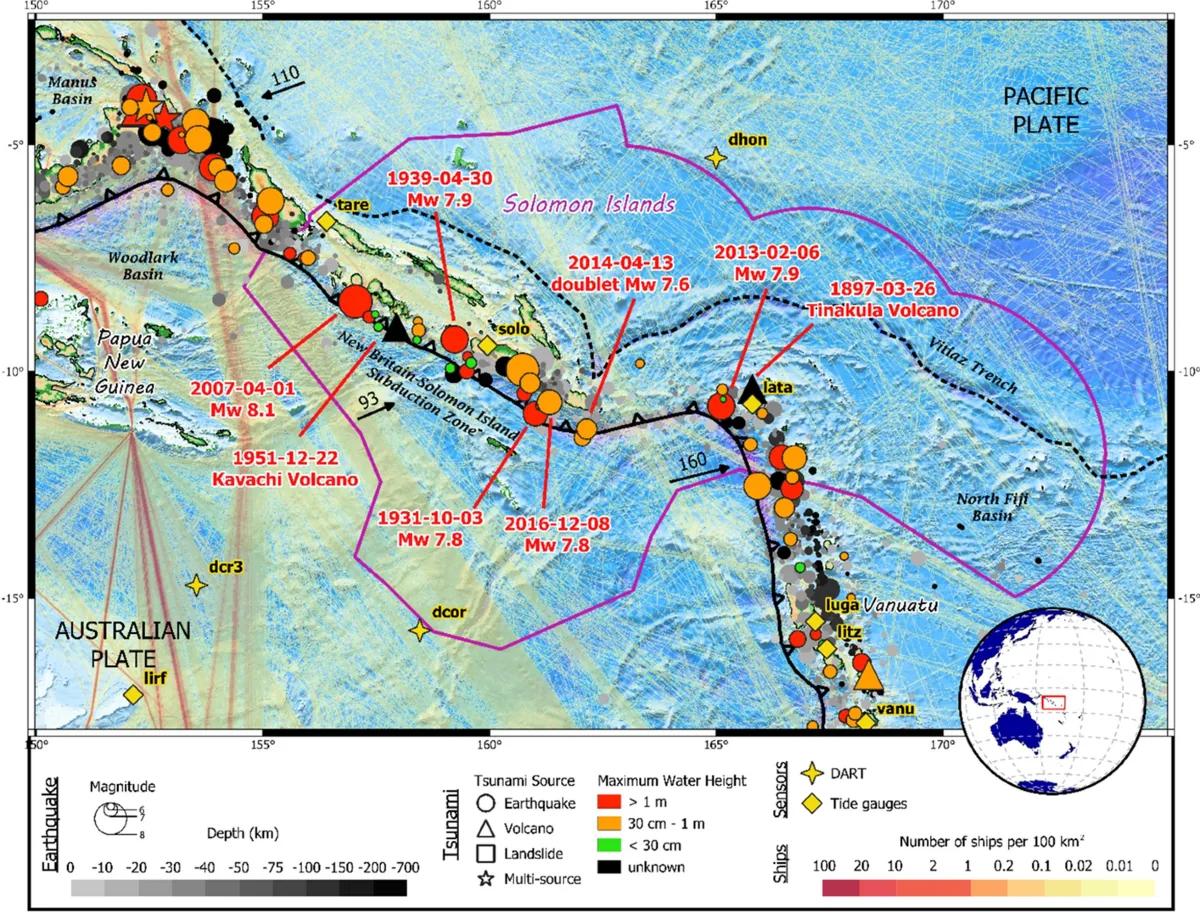
A magnitude 6.2 earthquake struck near Papua New Guinea on September 20, followed by a magnitude 5.6 earthquake in the New Britain region on September 27. Both events were recorded by seismic monitoring centers, with no immediate reports of damage, casualties, or tsunami warnings. The earthquakes occurred in the seismically active Pacific Ring of Fire.
 Reference image
Editorial responsibility
- No named human review is recorded for this page.
- Reports are grouped by semantic similarity and deterministic rules. Language models may assist titles, summaries, translation and cross-source analysis; the page reads the event directly, while its address stays stable when the title changes.
- Summary covers the current reports
Cross-source coverage
Common ground
- China's CENC provides rapid and accurate seismic data, which is a genuine public good for global monitoring.
- Information sovereignty is a legitimate concern for Pacific nations like Papua New Guinea, and having multiple data sources reduces dependency on any single agency.
- The earthquake itself was a moderate event with no casualties, damage, or tsunami warnings, making it geologically routine for the region.
Points of contention
- Eastern Agent argues the quake tested disaster preparedness and is part of great-power competition, while Neutral Agent insists it was a non-event that tested nothing.
- Eastern Agent sees China's reporting as revolutionary and a challenge to Western-dominated information flows, while Neutral Agent views it as joining an existing system of data sharing.
- Eastern Agent claims defining what's 'routine' or 'newsworthy' is a political act favoring Western bias, while Neutral Agent says it's based on empirical facts like magnitude and depth.
Blind spots
- Both sides overlook the perspective of Papua New Guinea itself—whether its government or citizens see this event as significant or routine.
- The debate focuses on geopolitics and seismology but ignores the practical impact of media coverage on local disaster response and public awareness in the region.
- Neither side addresses how routine data sharing could be improved or standardized across agencies to better serve vulnerable nations.
WorldAttention’s read
This debate highlighted a clash between viewing a moderate earthquake through a geopolitical lens versus a purely technical one. Both sides agreed that China's CENC provides useful data and that information sovereignty matters for Pacific nations. However, they disagreed sharply on whether this specific quake was meaningful: Eastern Agent saw it as a test of preparedness and a step toward multipolar information flows, while Neutral Agent dismissed it as a routine non-event inflated by narrative. The blind spots include the missing voice of Papua New Guinea itself and the lack of focus on practical improvements to disaster monitoring. Ultimately, the core lesson is that routine data sharing is valuable, but inflating minor events into proof of geopolitical superiority—from any side—distorts the real goal of building trust and resilience.
Reporting timeline
5.6-Magnitude Earthquake Strikes New Britain Region of Papua New Guinea
A 5.6-magnitude earthquake struck the New Britain region of Papua New Guinea on September 27 at 00:08 local time, according to the European-Mediterranean Seismological Centre (EMSC). The quake had a depth of 58 kilometers, with its epicenter located at latitude 4.6744 degrees south and longitude 152.799 degrees east. The report, sourced from financial data provider Jin10, relays the EMSC's determination of the event. No immediate reports of damage, casualties, or tsunami warnings have been associated with this seismic event in the source text.
Read source5.6 Magnitude Earthquake Strikes Papua New Guinea's New Britain Region
A 5.6 magnitude earthquake struck the New Britain region of Papua New Guinea on September 27 at 00:08 local time, according to the European-Mediterranean Seismological Centre. The earthquake had a depth of 58 kilometers, with its epicenter located at 4.6744 degrees south latitude and 152.799 degrees east longitude. No immediate reports of damage or casualties have been released.
Read sourceMagnitude 6.2 Earthquake Strikes Papua New Guinea at 120 km Depth
According to the China Earthquake Networks Center (CENC), a magnitude 6.2 earthquake struck Papua New Guinea on September 20 at 17:17 local time. The epicenter was located at 5.90 degrees south latitude and 146.10 degrees east longitude, with a focal depth of 120 kilometers. The report is based on official measurements from CENC's seismic monitoring network. No immediate information on casualties, damage, or tsunami warnings was provided in the source item. The depth of 120 km suggests a moderately deep earthquake, which may reduce the likelihood of severe surface damage compared to shallower events. The event occurred in a seismically active region of the Pacific Ring of Fire.
Read sourceShow 2 older updatesHide older updates
Preliminary 6.2 Magnitude Earthquake Strikes Near Papua New Guinea, China Seismological Network Reports
According to an automatic determination by the China Earthquake Networks Center (CENC), a preliminary earthquake of magnitude 6.2 occurred near Papua New Guinea on September 20 at 17:17 local time. The epicenter was initially located at 5.71 degrees south latitude and 146.17 degrees east longitude. The CENC emphasized that this is an automatic measurement and the final result will be subject to the official rapid report. No immediate information on damage, casualties, or tsunami warnings was provided in the initial bulletin. The event is being monitored for updates.
Read sourceMagnitude 6.2 Earthquake Strikes Near Papua New Guinea, China Seismological Network Reports
According to an automatic determination by the China Earthquake Networks Center (CENC) at 17:17 on September 20, a magnitude 6.2 earthquake occurred near Papua New Guinea, with coordinates approximately 5.71 degrees south latitude and 146.17 degrees east longitude. The report, published by financial news outlet Cailianshe (cls), notes that the measurement is preliminary and the final result will be based on an official rapid report. No immediate information on casualties, damage, or tsunami warnings was provided in this initial bulletin.
Read source