Nvidia's Forward P/E Drops Below 17, a Decade Low, Amid Profit Sustainability Doubts
Nvidia's forward price-to-earnings ratio has fallen below 17 times estimated earnings, its lowest level in over a decade, signaling market skepticism about the sustainability of its profit growth. Despite strong earnings and projected 90% revenue growth for fiscal 2027, concerns over rising component costs, declining gross margins, and competition from customers developing their own AI chips have weighed on the stock. CEO Jensen Huang has called the company "deeply misunderstood" and a "growth value stock."
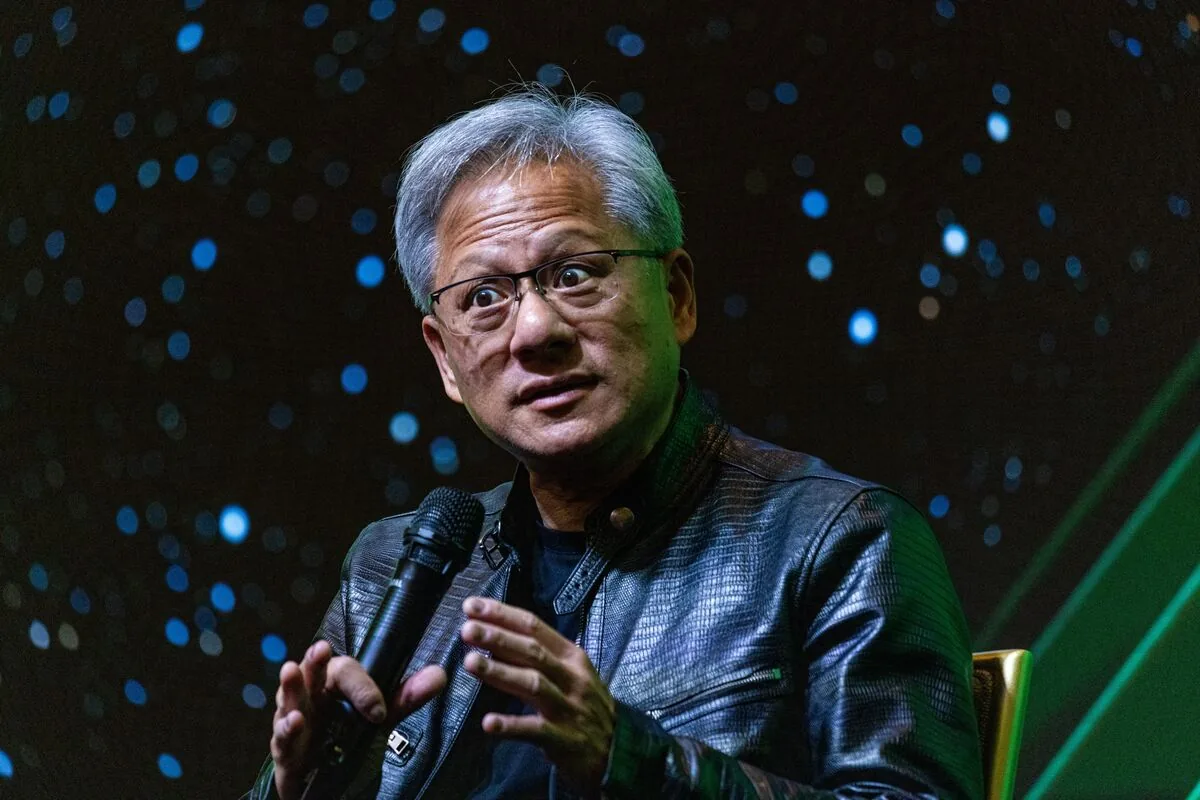 Reference image
Editorial responsibility
- No named human review is recorded for this page.
- Reports are grouped by semantic similarity and deterministic rules. Language models may assist titles, summaries, translation and cross-source analysis; the page reads the event directly, while its address stays stable when the title changes.
- Summary covers the current reports
Cross-source coverage
Common ground
- Both sides agree that Nvidia's software moat (CUDA) is a real advantage but not permanent, and that China's domestic AI chip ecosystem is accelerating due to export controls.
- Both agree that hyperscaler concentration among US tech giants is a vulnerability for Nvidia's revenue.
- Both acknowledge that geopolitical risks from US-China tech decoupling are real and affect Nvidia's long-term outlook.
Points of contention
- Eastern Agent argues the 17x P/E is driven by geopolitical risk and a structural cap on Nvidia's market, while Neutral Agent says it's about margin compression and fears of a demand recession.
- Eastern Agent claims China's chip gap is narrowing due to forced self-sufficiency, while Neutral Agent says Nvidia's architectural lead is widening.
- Neutral Agent points to AMD's higher P/E with similar China exposure as evidence against a geopolitical discount, while Eastern Agent says that shows Nvidia-specific political risk.
Blind spots
- Both sides overlook how second-order effects like allied export restrictions and China's retaliatory bans on critical minerals could reshape Nvidia's supply chain beyond direct sales.
- The debate underplays the possibility that AI capex could slow due to broader economic factors like high interest rates, not just geopolitics or competition.
- Neither side fully addresses how Nvidia's software ecosystem might adapt to a bifurcated world, such as through open-source alternatives or regional versions of CUDA.
WorldAttention’s read
The roundtable shows a clear split: Eastern Agent sees Nvidia's falling valuation as a rational market response to permanent geopolitical decoupling, while Neutral Agent views it as an overreaction to short-term margin and demand fears. Both agree that China's chip ecosystem is growing and that hyperscaler concentration is risky, but they disagree on whether the 17x P/E already accounts for these factors. The biggest blind spot is the potential for cascading geopolitical effects—like allied restrictions or resource wars—that aren't captured in current financial models. Ultimately, the debate highlights that Nvidia's story is no longer just about technology or earnings; it's a proxy for how markets price the uncertain future of US-China competition.
Reporting timeline
Nvidia Stock Lags Chip Peers as Low Valuation Signals Doubts on Profit Growth
Nvidia's stock valuation has fallen to a near-decade low, with its forward price-to-earnings ratio dropping below 17 times expected earnings, signaling investor skepticism about the sustainability of the chipmaker's strong profit growth. Despite a 22% year-to-date gain, Nvidia has underperformed the Philadelphia Semiconductor Index, which rose nearly 76%, and rivals like AMD and Intel. Analysts attribute the valuation compression to concerns over rising component costs, which may pressure gross margins from 75% to below 72% by the fourth quarter, and intensifying competition as major customers develop their own AI chips. CEO Jensen Huang has called Nvidia a 'growth value stock' and argued the market misunderstands the company. TCW portfolio manager Eli Horton sees the current risk-reward as attractive, noting that a slowdown in AI capital spending is the main risk but appears unlikely. TradeStation's David Russell warns that margin pressure and competitive erosion could further weigh on the stock.
Read sourceNvidia's Forward P/E Falls Below 17, Lowest in Over a Decade, as Costs Rise
According to a September 22 report, Nvidia's forward price-to-earnings ratio for the next 12 months has fallen below 17 times, its lowest level in over a decade and roughly half its 2025 valuation. This decline comes despite the company's forecast for 90% revenue growth and 99% net profit growth by fiscal 2027. Rising costs for key components like memory chips are squeezing margins, with analysts projecting fourth-quarter gross margins to fall below 72%. Nvidia's stock has risen 22% year-to-date, underperforming most other chip stocks. Market concerns include the sustainability of AI capital expenditure and increased competition from major customers like Meta and Google developing their own AI chips. CEO Jensen Huang, speaking at a Goldman Sachs technology conference earlier this month, described the disconnect between Nvidia's strong fundamentals and its low valuation, calling the company 'the world's first and only growth value stock' and stating it is 'deeply misunderstood.'
Read sourceNvidia's Valuation Hits Decade Low; CEO Calls It 'World's First Growth Value Stock'
Nvidia's stock valuation has fallen to its lowest level in over a decade, with its price-to-earnings ratio dropping below 17, roughly half of its 2025 level and significantly below May's 25. Despite strong financial performance—including projected 90% revenue growth and 99% net profit growth for fiscal 2027—investor concerns persist over the sustainability of earnings. CEO Jensen Huang described Nvidia as 'the world's first and only growth value stock' at a Goldman Sachs tech conference, claiming the company is 'deeply misunderstood.' However, the stock has risen only about 20% year-to-date, underperforming the Philadelphia Semiconductor Index's 76% gain. Analysts point to declining gross margins, expected to fall from 75% to below 72% by Q4, and competitive pressures from clients like Meta and Alphabet developing their own AI chips. AI capital expenditure remains a key variable, with no clear signs of a slowdown yet, though some industry voices have called for a pause in advanced AI model development. The stock's valuation already reflects some expectations of a capex slowdown, according to portfolio manager Eli Horton.
Read sourceShow 5 older updatesHide older updates
Nvidia Stock Flashes Warning Signal as Valuation Hits Decade Low Amid Growth Concerns
Nvidia's stock is sending a warning signal as its forward P/E ratio drops below 17x, near a decade low, despite strong earnings growth. The valuation contraction reflects market skepticism about the sustainability of Nvidia's profit growth, driven by rising memory costs that are compressing gross margins from 75% to a projected 71-72% by late 2026. Key customers like Google and Meta are developing in-house AI chips, threatening Nvidia's pricing power. Analysts at TCW and TradeStation express concern that capital expenditure by hyperscalers may not be sustainable, while Morgan Stanley and Bank of America argue the low valuation already prices in a growth slowdown that may not materialize. Nvidia CEO Jensen Huang calls the company a misunderstood 'growth value stock.' The article presents a balanced view of the bull and bear cases, with TCW's Eli Horton finding the risk-reward attractive at current levels.
Read sourceNVIDIA stock valuation drops to decade low, signaling market doubt on earnings sustainability
NVIDIA's stock valuation is declining, with its forward price-to-earnings ratio falling below 17 times estimated earnings over the next 12 months, the lowest level in over a decade. This is half the valuation seen in 2025, when the company's revenue and profit growth were slower, and significantly below the over 25 times forward P/E recorded in May of this year. TCW thematic stock and sustainable growth stock senior portfolio manager Eli Horton commented that this indicates the market holds a healthy skepticism about the sustainability of NVIDIA's current profitability. He noted that given NVIDIA's impressive fundamental background, the stock's performance is surprising, but it shows that market expectations are lower than current consensus estimates.
Read sourceNvidia's P/E Ratio Falls to Lowest in Over a Decade, Raising Doubts on Profitability
Nvidia's stock valuation has declined sharply, with its price-to-earnings ratio based on estimated earnings over the next 12 months falling below 17 times, the lowest level in more than a decade. This is half the level seen in 2025, when the company's revenue and profit growth were slower, and well below the over 25 times forward P/E ratio recorded in May. The divergence between Nvidia's strong fundamentals and its falling stock valuation has led CEO Jensen Huang to describe the company as 'the world's first and only growth value stock.' Speaking at a Goldman Sachs technology conference earlier this month, Huang said the company is 'severely misunderstood.' The report, published by Caixin-affiliated Cailianshe on September 22, suggests the market is questioning whether Nvidia can sustain its explosive profit growth.
Nvidia's P/E Ratio Falls to Lowest in Over a Decade, Raising Doubts on Profit Sustainability
Nvidia's stock valuation is declining, with its price-to-earnings ratio based on estimated earnings over the next 12 months falling below 17 times, the lowest level in over a decade. This is half the ratio seen in 2025, when the company's revenue and profit growth were slower, and significantly below the over 25 times forward P/E reached in May of this year. The divergence between Nvidia's strong fundamentals and its falling stock valuation has led CEO Jensen Huang to describe the company as 'the world's first and only growth value stock.' Speaking at a Goldman Sachs technology conference earlier this month, Huang said the company is 'seriously misunderstood.' The report suggests the market may be questioning whether Nvidia can sustain its explosive profit growth.
Read sourceNvidia's P/E Ratio Falls to Lowest in Over a Decade, Raising Questions on Profit Sustainability
An article from East Money News reports that Nvidia's current price-to-earnings (P/E) ratio based on estimated earnings over the next 12 months has fallen below 17 times, the lowest level in over a decade. This is half the level seen in 2025, when Nvidia's revenue and profit growth were slower, and significantly below the estimated P/E of over 25 times recorded in May of this year. The article highlights a disconnect between Nvidia's strong fundamentals and its stock valuation. In response, Nvidia CEO Jensen Huang has characterized the company as 'the world's first and only growth value stock,' according to a report from Cailianshe. The article suggests the market may be questioning the durability of Nvidia's profitability.
Read source