Nvidia CEO pledges to double chip sales next year, backing 70% revenue growth forecast
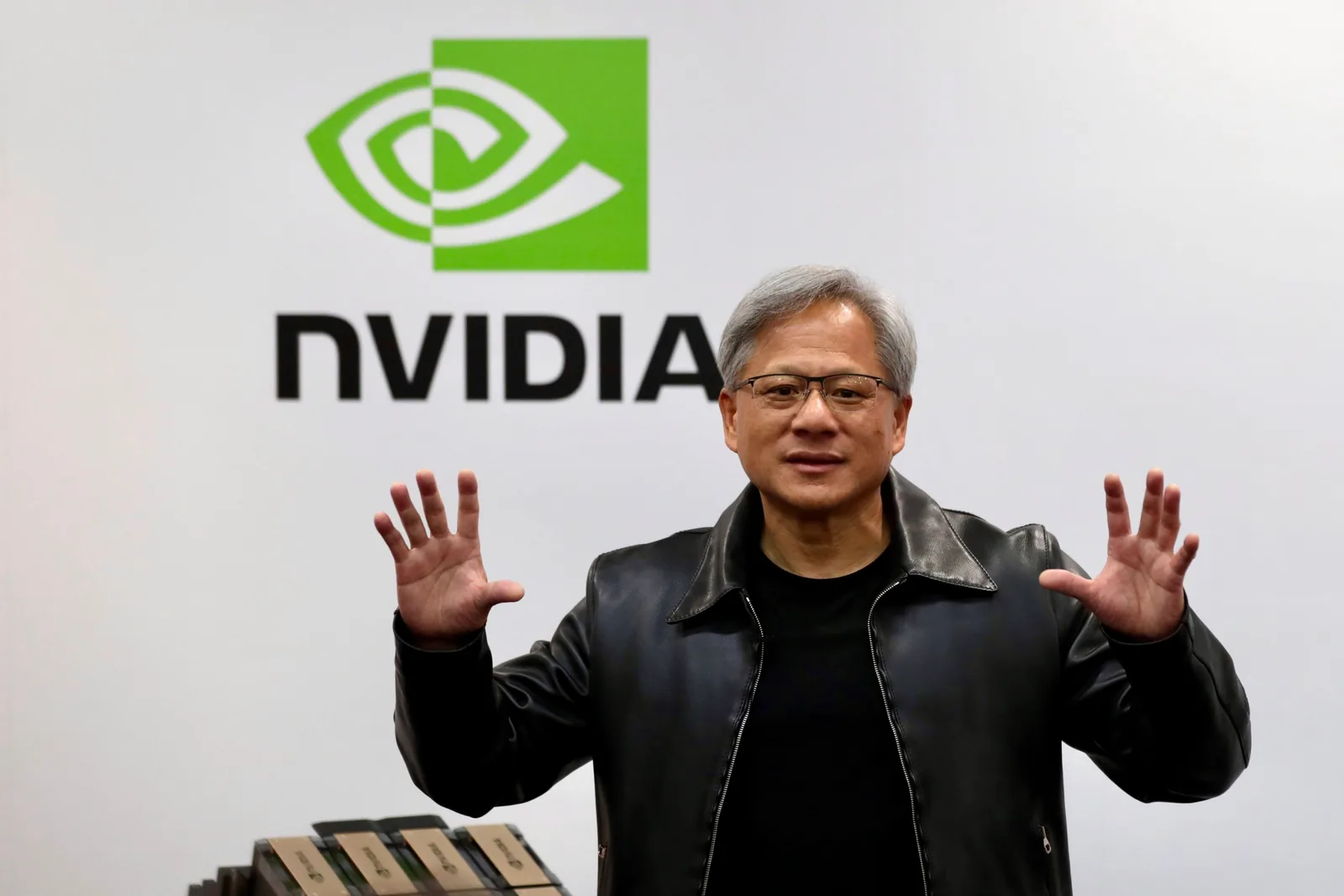
Nvidia CEO Jensen Huang told reporters at a September 2026 AI summit in Scotland that the company expects to sell twice as many chips next year as it ships this year. This reinforces the 70% fiscal 2028 revenue growth forecast CFO Colette Kress laid out on the August 26 earnings call, which exceeded the prior Wall Street consensus of roughly 44% growth. Huang cited broadening AI demand beyond hyperscalers to sovereigns, NeoClouds, and enterprises. Supply constraints, particularly memory scarcity, remain the primary bottleneck.
 Reference image
Editorial responsibility
- No named human review is recorded for this page.
- Reports are grouped by semantic similarity and deterministic rules. Language models may assist titles, summaries, translation and cross-source analysis; the page reads the event directly, while its address stays stable when the title changes.
- Summary covers the current reports
Cross-source coverage
Common ground
- Both sides agree that Nvidia's growth projections face real operational constraints, including TSMC's packaging capacity and energy infrastructure limits.
- There is agreement that vendor financing to startups carries genuine financial risk, even if the mechanics are debated.
- Both acknowledge that export controls on China are a key factor shaping Nvidia's sales trajectory.
- Both recognize that AI development raises significant societal questions about power concentration and democratic oversight.
Points of contention
- The Neutral Agent argues Nvidia is just a chip company selling general-purpose hardware, while the Western Agent says it bears moral responsibility for how its products are used.
- The Western Agent calls for a voluntary pause on AI chip deployment, but the Neutral Agent says that would hand the market to China and is not a serious policy proposal.
- The Neutral Agent sees regulation as the government's job, while the Western Agent argues companies must act before laws catch up, citing past tech crises.
- The Western Agent frames the energy issue as a political choice between AI and public goods, while the Neutral Agent sees it as a grid investment problem.
Blind spots
- Neither side fully explores how quickly renewable energy could scale to meet AI's power demands, treating it as either a technical or political problem without concrete solutions.
- The debate overlooks the role of smaller AI chip competitors and whether they could disrupt Nvidia's dominance, focusing only on Nvidia and China.
- Both agents assume AI demand will remain high, without considering a potential demand collapse from regulatory crackdowns or a bubble burst.
WorldAttention’s read
The debate reveals a fundamental clash between operational realism and moral urgency. The Neutral Agent makes a strong case that Nvidia's doubling claim is constrained by packaging capacity, energy limits, and risky vendor financing, and argues that the real solution lies in government export controls and the CHIPS Act, not a voluntary corporate pause. The Western Agent counters that this technical focus ignores the historical pattern of companies externalizing harm until it's too late, and insists Nvidia must take responsibility for building infrastructure that could destabilize society. Both sides agree on the risks but disagree on who should act—companies or governments. The blind spot is that neither offers a concrete path for how democratic oversight could keep pace with exponential deployment, leaving the core question unanswered: who decides what this technology does to our world?
Reporting timeline
Nvidia CEO Jensen Huang pledges to double AI chip sales next year, backing 70% revenue growth forecast
Nvidia CEO Jensen Huang told reporters at a September 2026 AI summit in Scotland that the company expects to sell twice as many chips next year as it ships this year. This pledge reinforces the 70% fiscal 2028 revenue growth forecast that CFO Colette Kress laid out on the August 26, 2026 earnings call, which far exceeded the prior Wall Street consensus of roughly 44% growth. Kress described the target as constrained by available supply, with memory scarcity being the biggest bottleneck. Analysts note that Nvidia has never issued guidance this far into the future, creating uncertainty. Huang's confidence rests on broadening AI demand beyond hyperscalers to sovereigns, NeoClouds, and enterprises, which already represent roughly half of Nvidia's data center business and are growing at approximately 100% annually. The stock is roughly 6% below its May 2026 all-time high.
Read sourceNvidia CEO Jensen Huang Forecasts Doubling of Chip Sales Next Year, Stock Seen as Bargain
An article from The Motley Fool on Yahoo Finance reports that Nvidia CEO Jensen Huang stated during a speech in Scotland that the company could sell twice as many chips next year compared to this year. This forecast comes as Nvidia begins shipping its next-generation Vera Rubin data center system, which offers up to 30 times more performance than the previous Blackwell Ultra system and reduces inference token costs by 97%. The article notes that Nvidia is on track for $411 billion in revenue in fiscal 2027, with analysts expecting nearly $700 billion in fiscal 2028. Despite a low P/E ratio of 28.1, the article identifies risks: hyperscaler spending of $800 billion this year could be disrupted by rising interest rates; leading AI labs have agreed to potentially slow development due to safety concerns; and Nvidia is financing about 25% of its fiscal 2028 sales to customers. The author concludes the stock is still a buy given the low valuation.
Read sourceJensen Huang Announces Nvidia Will Double Chip Sales Next Year, Citing AI Demand
In a September 2026 article from The Motley Fool on Yahoo Finance, analyst Adria Cimino reports that Nvidia CEO Jensen Huang announced the company plans to double the number of chips sold next year compared to this year. Speaking at a summit in Scotland, Huang attributed the forecast to widespread global investment in AI across industries and countries. This follows Nvidia's first-ever full-year revenue forecast of 70% year-over-year growth for the next fiscal year. The article notes that despite investor concerns about the sustainability of AI infrastructure spending, Huang's comments reinforce the case for continued AI-driven growth for Nvidia. The piece also includes promotional content for Motley Fool's stock-picking services, noting that Nvidia was not among their current top 10 recommended stocks.
Show 2 older updatesHide older updates
Jensen Huang Announces Nvidia Will Double Chip Sales Next Year, Boosting AI Outlook
In a September 20, 2026 article on Yahoo Finance, Motley Fool analyst Adria Cimino reports that Nvidia CEO Jensen Huang announced at a summit in Scotland that the company plans to double the number of chips sold next year compared to this year. Huang attributed the growth to widespread global demand for AI investment across industries and economies. This follows Nvidia's first-ever full-year forecast, predicting a 70% year-over-year revenue gain in the next fiscal year. The article notes that Nvidia's revenue climbed over 100% to about $96 billion in the latest quarter, with profit surging to $59 billion. Despite investor concerns about the sustainability of AI capital spending, Huang's comments reinforce the case that Nvidia's AI revenue growth opportunity is far from over, potentially entering a fresh wave of growth as AI is more actively applied by companies, individuals, and governments. The article concludes that this news offers comfort to shareholders and potential investors about future business prospects.
Nvidia CEO Jensen Huang Forecasts Chip Sales Will Double Next Year on AI Demand
Nvidia CEO Jensen Huang stated at a summit in Scotland that the company expects to sell twice as many chips in 2025 as it did in 2024, driven by surging demand for artificial intelligence across industries and economies worldwide. He noted that the current bottleneck is not demand but Nvidia's ability to produce chips, and the company has been diversifying its supply chain and securing multi-year agreements for key components. Huang also addressed AI safety, opposing a pause in AI development but advocating for restricting unsafe products until they are improved. The forecast follows Nvidia's earlier projection of 70% revenue growth for the fiscal year ending January 2028, reaching approximately $673 billion, which prompted analysts to raise expectations. Wall Street remains bullish, with 30 analysts giving the stock a 'buy' rating over the past three months. Huang attended the summit alongside representatives from Google DeepMind, OpenAI, and Anthropic, focusing on AI safety discussions.
Read source