New York City Council Votes to Phase Out Horse-Drawn Carriages by 2028
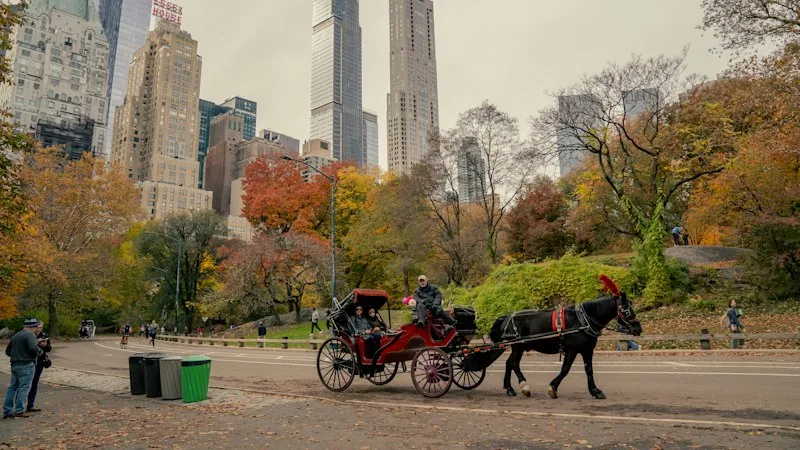
The New York City Council passed legislation to phase out horse-drawn carriages in Central Park by 2028, ending a tradition of roughly 160 to 170 years. The ban, named Romanch's Law after an 18-year-old tourist who died in a June carriage accident, was backed by Mayor Zohran Mamdani and animal-welfare groups. About 200 drivers fear losing their livelihoods, the Transport Workers Union says the transition plan lacks guarantees, and opponents including President Donald Trump have criticized the move, with drivers threatening a lawsuit.
 Illustration
Editorial responsibility
- No named human review is recorded for this page.
- Reports are grouped by semantic similarity and deterministic rules. Language models may assist titles, summaries, translation and cross-source analysis; the page reads the event directly, while its address stays stable when the title changes.
- Summary covers the current reports
Cross-source coverage
Common ground
- The animal welfare case for ending horse carriage work in Midtown traffic is strong.
- A ban is easy, but a just transition is hard and has not been adequately planned.
- The four-year phase-out to 2028 lacks published details on funding, driver support, or where the horses will go.
- The source material and public coverage are thin, and no one in the debate actually read the bill text.
- The debate became a culture-war symbol, which distracts from the practical transition questions.
Points of contention
- Whether the thin transition funding is mainly caused by the culture-war spotlight or is just political laziness.
- Whether the '200 jobs' figure is a genuine labor concern or a convenient talking point for ban opponents.
- Whether the '40 horse deaths since 1982' number is meaningful without a denominator like total horses or shifts.
- Whether the absence of a driver survey reflects bad faith or simply neglect by the City Council.
- Whether the welfare case alone justifies a ban, or whether the transition plan must be equally strong.
Blind spots
- No one produced the actual bill text, so all claims about funding and transition are speculation.
- No one asked what the drivers themselves want, such as buyouts, retraining, or continued work.
- No one identified where the roughly 200 horses will physically go in 2028, beyond scare lines about slaughter.
- No one provided a real risk number, like injuries per shift or per horse, to replace the raw '40 deaths' figure.
- No one explained who was responsible for planning the transition, or why that responsibility was ignored.
WorldAttention’s read
The debate agrees that ending horse carriages in Midtown is a serious animal-welfare question, but the real failure is that no one has seen the actual plan. A ban is a decision; a transition is a plan. We got the decision, but the transition is unwritten, unfunded, and unexamined. Until someone opens the bill and answers where the horses go and what happens to the drivers, this policy is a headline, not a solution.
Reporting timeline
NYC Votes to End 170-Year Horse Carriage Tradition as Trump Blasts Ban
New York City has voted to end its nearly 170-year-old horse-drawn carriage tradition, with the City Council passing a law to phase out the carriages by 2028. The ban, which affects Central Park's iconic carriage rides, has drawn criticism from President Donald Trump, who blasted the decision. Carriage drivers are threatening a lawsuit and fear for their future livelihoods. The legislation marks the end of a longstanding New York City tradition, with animal welfare groups celebrating the move while opponents vow to fight it in court.
Read sourceNew York City Council Votes to Ban Horse-Drawn Carriages From June 2028
The New York City Council officially voted in favor of a push by Mamdani to ban horse-drawn carriages in the city, ending the historic tourist tradition beginning June 2028. The vote marks a formal policy decision by the Council, with the ban scheduled to take effect in June 2028. The measure targets the long-running carriage industry that has operated in the city as a tourist attraction. No further details on implementation, exemptions, or transition arrangements were included in the source item.
Read sourceNYC passes bill to ban horse-drawn carriages by 2028
New York City has passed legislation to ban horse-drawn carriages, with reports indicating the phase-out is set to be completed by 2028. The measure ends a long-standing Central Park tradition. According to NBC News, The Boston Globe, and other outlets, carriage drivers in Central Park fear for their future following the vote. The New York Times described the move as ending a Central Park tradition, while ABC7 New York reported that the City Council passed the law to phase out the carriages by 2028. Humane World for Animals also reported the development as breaking news, saying New York City has ended the use of carriage horses. The coverage highlights both the policy decision and the uncertainty facing drivers whose livelihoods depend on the carriage industry.
Read sourceShow 3 older updatesHide older updates
NYC Council Votes to Phase Out Horse-Drawn Carriages by 2028
The New York City Council has passed legislation to phase out the city's horse-drawn carriage industry by 2028, a move reported by multiple outlets including ABC7 New York and Fox 5 New York. The New York Times framed the action as a ban, while USA Today described the 160-year-old tradition as headed for extinction. Fox News reported that Mamdani is expected to face legal trouble over the PETA-backed horse carriage ban. The vote was characterized as historic on whether to keep the carriage industry in NYC. The measure sets a 2028 deadline for the industry's phase-out, though the Fox News report signals potential legal challenges ahead.
Read sourceNYC Council passes horse carriage ban as Mamdani faces expected legal challenge
The New York City Council has passed a law to phase out horse-drawn carriages by 2028, a measure backed by PETA. Fox News reports that Zohran Mamdani is expected to face legal trouble over the PETA-backed horse carriage ban. The New York Times notes the Council was set to ban the carriages, while 6abc Philadelphia confirms the law phases them out by 2028. BBC coverage frames the debate as New York City reconsidering a classic attraction and asking whether horse-drawn carriages constitute abuse. 9News reports that Central Park's carriage drivers fear for their livelihoods as the ban approaches. The legislation represents a significant change to a long-standing New York City tourism tradition, with legal and economic consequences still unfolding.
Read sourceNew York City Council Moves to Ban Horse-Drawn Carriages in Central Park
New York City Council is expected to vote to ban horse-drawn carriages in Central Park starting June 2028, a proposal backed by Mayor Zohran Mamdani. The ban, named Romanch's Law after an 18-year-old tourist who died in a carriage accident in June, follows years of animal-safety and public-safety concerns. Roughly 200 drivers, who say they are devoted to their horses and dispute mistreatment claims, fear losing their livelihoods; the Transport Workers Union says the transition plan lacks guarantees and could leave workers "economically wiped out." Animal-rights activists and some New Yorkers and tourists welcome the ban, while other visitors see the carriages as part of the city's culture.