Andreessen Horowitz launches $42M Horowitz-Andreessen Academy as college alternative
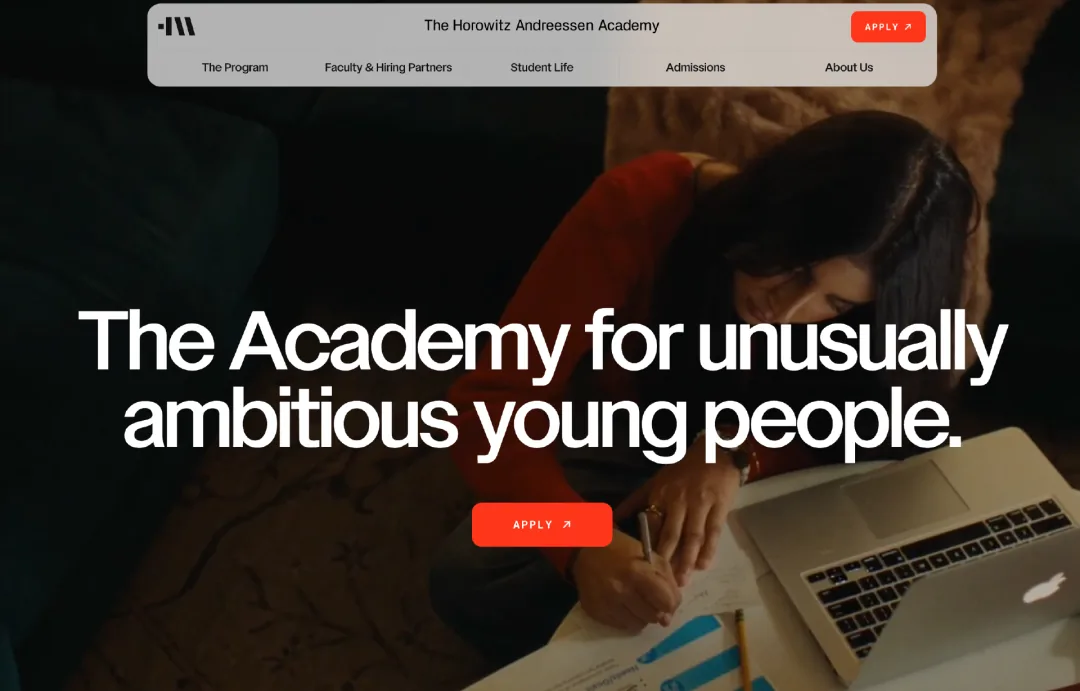
Venture capital firm Andreessen Horowitz (a16z) has launched the Horowitz-Andreessen Academy, a full-time, in-person educational institution in San Francisco targeting high school graduates. The academy has raised $42 million, with a16z contributing $35 million. The inaugural one-year program starts in fall 2027, enrolling about 50 students tuition-free (room and board not covered). Founding partners include Nvidia, Google, Meta, OpenAI, Anthropic, and Palantir. The academy is not yet accredited and does not offer a degree.
 Reference image
Editorial responsibility
- No named human review is recorded for this page.
- Reports are grouped by semantic similarity and deterministic rules. Language models may assist titles, summaries, translation and cross-source analysis; the page reads the event directly, while its address stays stable when the title changes.
- Summary covers the current reports
Cross-source coverage
Common ground
- Both agree the academy lacks accreditation and accountability, leaving students with no formal credential or recourse if things go wrong.
- Both agree the program targets a privileged subset of students who can afford to gamble a year without a guaranteed job or degree.
- Both agree elite universities already act as corporate talent pipelines, complicating any simple critique of this academy.
- Both agree the academy's narrow focus on AI training is risky if the AI job market cools or collapses.
Points of contention
- Western Agent sees the academy as a deliberate political project to delegitimize public universities, while Neutral Agent views it as a market response to a genuine talent shortage.
- Western Agent argues the $840,000 per student cost is a feature that signals elite grooming, while Neutral Agent insists it's an unsustainable loss leader that won't scale.
- Western Agent believes this is a template for venture capital to replicate across sectors, while Neutral Agent says the economics don't support replication.
- Neutral Agent thinks the academy could force universities to compete on outcomes, while Western Agent argues it undermines the fight for better public education.
Blind spots
- Neither fully addresses what happens to the majority of students who don't become founders or top coders—the 48 out of 50 who may end up with no degree and a worthless network.
- Both overlook the broader political and economic forces—like slashed public funding and student debt—that make such private experiments appealing in the first place.
- Neither explores how this model could be adapted for non-tech sectors or how it might evolve if the AI hype cycle ends.
WorldAttention’s read
This debate reveals a deep split between seeing the academy as a dangerous power grab by venture capital or as a boutique experiment responding to real market failures. Both sides agree on the lack of accountability and the risk to students, but they disagree on whether this is a deliberate attack on public education or just a loss leader that will likely fizzle out. The biggest blind spot is the students themselves—especially the ones who don't become unicorn founders—and the broader crisis in higher education that makes such experiments possible. Ultimately, the academy is a symptom of a broken system, not a solution, and the real fight should be for better public universities, not just against this one private project.
Reporting timeline
VC Firm a16z Launches Full-Time Academy with Nvidia, Google, and OpenAI as Partners
Andreessen Horowitz (a16z) has announced the launch of the Horowitz-Andreessen Academy, a full-time, in-person educational institution in San Francisco targeting high school graduates. The academy aims to prepare students for a world transformed by AI, focusing on project-based learning, industry mentorship, and practical experience rather than traditional exams and homework. a16z has invested $35 million in the venture, which has raised $42 million total. The inaugural one-year program, starting in fall 2027, will enroll about 50 students tuition-free (though room and board are not covered) and does not yet offer a degree. Founding partners include Nvidia, Google, Meta, OpenAI, Anthropic, and Palantir, with guest lecturers such as Sam Altman, Jensen Huang, Fei-Fei Li, Satya Nadella, and Naval Ravikant. The academy plans to seek accreditation for a two-year program in 2028. a16z partner Eric Torenberg stated that the institution is built for a world where education and work will differ fundamentally from previous generations. Co-founder Ben Horowitz noted that while college remains a good option for most, some students no longer fit that model and could benefit from this alternative.
Andreessen Horowitz invests $35 million in unaccredited two-year college alternative
Venture-capital firm Andreessen Horowitz is investing $35 million in an unaccredited two-year alternative to traditional college, urging up-and-coming tech talent not to drop out of school to start a company but to join their program instead. The initiative aims to provide a structured educational path for aspiring entrepreneurs, offering an alternative to both dropping out and traditional higher education. The investment underscores the firm's bet on non-traditional education models to cultivate tech talent, though the program remains unaccredited. The announcement was made via a social media post linking to a Wall Street Journal article, indicating a strategic shift in how the firm engages with young founders.
Read sourceTech elites launch college alternative to nurture next generation of AI geniuses, raises $42M
A group of tech elites, led by venture capital firm Andreessen Horowitz (a16z), has launched a new educational initiative as an alternative to traditional college, aimed at nurturing the next generation of AI talent. The program, referred to as the Horowitz Andreessen Academy or an AI school, has raised $42 million in funding. The initiative challenges Silicon Valley's historical preference for college drop-outs by creating a structured educational path focused on artificial intelligence. The news was widely reported by multiple outlets including the New York Post, Bloomberg, TechCrunch, and the Wall Street Journal, with a16z also publishing a blog post about the academy. The school is designed to incubate young talent specifically for careers in AI, reflecting a growing demand for specialized expertise in the field.
Read sourceShow 2 older updatesHide older updates
Andreessen Horowitz launches free AI school for high school graduates and college dropouts
Venture capital firm Andreessen Horowitz has announced the launch of a free artificial intelligence school targeting high school graduates and college dropouts. The initiative is positioned as an alternative to traditional elite universities, aiming to provide accessible AI education without the cost of higher education. The announcement was made via a post on the social media platform X, with the source media type listed as Polymarket. The school's curriculum, faculty, and application process have not been detailed in the initial announcement, but the move signals a significant push by the prominent Silicon Valley firm to expand AI talent development outside conventional academic pathways.
Andreessen Horowitz Launches AI School as a College Alternative
Venture capital firm Andreessen Horowitz (a16z) has announced the launch of an 'AI school' or 'academy' intended as an alternative to traditional college education. The program, as reported by multiple outlets including Bloomberg, TechCrunch, The Verge, and the Wall Street Journal, will feature no homework and includes partnerships with major tech companies such as Palantir, Google, and Meta. The initiative is seen as challenging Silicon Valley's traditional embrace of college drop-outs by offering a structured educational path focused on artificial intelligence. The a16z website also published a piece titled 'Incubating The Horowitz Andreessen Academy,' indicating the firm's direct involvement in developing this educational program.
Read source