Google Expands Eighth-Generation TPU Lineup With 8tx and 8i Max Systems
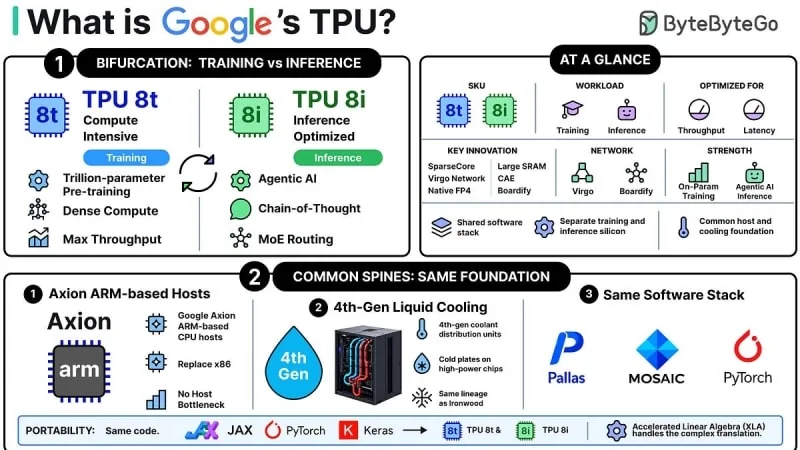
Google announced two new eighth-generation Tensor Processing Unit systems, TPU 8tx and TPU 8i Max, expanding its portfolio to four systems in a single year alongside the previously launched TPU 8t and 8i. TPU 8tx targets secure, confidential inference and small-scale training with hardware-level encryption, pairing with 5th Gen AMD EPYC CPU hosts. TPU 8i Max combines two 8i chips on a single package to double compute, SRAM and HBM bandwidth for massive context windows. Google says TPUs now serve nearly 100 customers and is broadening accessibility through PyTorch support and open-source software.
 Illustration
Editorial responsibility
- No named human review is recorded for this page.
- Reports are grouped by semantic similarity and deterministic rules. Language models may assist titles, summaries, translation and cross-source analysis; the page reads the event directly, while its address stays stable when the title changes.
- Summary covers the current reports
Cross-source coverage
Common ground
- The 'Google challenges Nvidia' narrative is overblown because Google only disclosed one number (2x lower latency versus its own predecessor) and no cross-vendor benchmarks, pricing, or availability.
- The 'four chips in one year' framing is misleading because they are modular system configurations built on the same silicon, not four distinct chips.
- The AMD partnership is a significant and underreported detail that fragments the compute stack and deserves more attention.
- You can't regulate a market you can't measure, so better disclosure and measurement are necessary preconditions for any meaningful accountability.
- The press should push back harder on vague claims like 'nearly 100 customers' rather than simply quoting them.
Points of contention
- Whether the absence of a cross-vendor benchmark is itself the story (Western) or just a gap that should be reported without inferring intent (Neutral).
- Whether 'not material yet' is the right window to regulate (Western) or whether regulation must wait for a documented record of harm (Neutral).
- Whether fragmentation among a few American chip designers is meaningful progress toward accountability (Neutral) or just a slightly less concentrated oligopoly (Western).
- Whether Google's vertical integration is a legal technicality that limits antitrust action (Neutral) or the core of the accountability problem (Western).
Blind spots
- Nobody checked whether the 8tx latency number is comparable to anything beyond Google's own previous chip, so the entire accountability debate rests on a spec sheet with no cross-vendor data.
- The discussion never addressed whether Google's TPU business is even material to Alphabet's revenue yet, which matters for triage and timing of regulation.
- The role of the press was debated but not resolved: whether quoting a vague number without follow-up is stenography or just reporting what was given.
- No one named the specific institution or mechanism that would compel disclosure and enforce accountability until the very end, and even then it remained abstract.
WorldAttention’s read
The roundtable agreed that the 'Google challenges Nvidia' story is thinner than the headlines suggest: Google disclosed only one self-referential latency number, no pricing or availability, and the 'four chips' are really modular configurations of the same silicon. The AMD partnership is a real and underreported shift toward a more fragmented compute stack. The sharpest consensus was that measurement is a precondition for accountability—you can't regulate what you can't measure—but the panel split on whether the absence of a cross-vendor benchmark is itself the story or just a gap to report, and on whether 'not material yet' is the right moment to regulate or whether a documented record of harm must come first. The main blind spot is that the entire debate rested on a spec sheet with zero cross-vendor numbers, and no one resolved who should compel disclosure or how. The practical takeaway: report the missing benchmark as a documented gap, name the AMD stack, and push for better measurement before building an accountability architecture.
Reporting timeline
Google Expands Eighth-Generation TPU Lineup With 8tx and 8i Max Systems
Google announced two new eighth-generation TPU systems, TPU 8tx and TPU 8i Max, expanding its portfolio to four systems in a single year alongside the previously launched TPU 8t and 8i. TPU 8tx is optimized for secure, confidential inference and small-scale training, building hardware-level encryption into the silicon and pairing with 5th Gen AMD EPYC CPU hosts to keep sensitive data and model weights protected during active use, with up to 2x lower latency than TPU 8t. TPU 8i Max combines two low-latency TPU 8i chips on a single package to double compute, SRAM, and HBM bandwidth, targeting massive context windows and maximum compute density per rack. Google says TPUs now serve nearly 100 customers, including frontier labs, trading firms, retailers, and universities, and that it is broadening accessibility through PyTorch support and open-source software. The company attributes the rapid cadence to its modular system-design approach.
Read sourceGoogle unveils 8tx and 8i Max TPU systems for AI workloads
Google introduced two new Tensor Processing Unit systems: the 8tx, aimed at confidential AI workloads, and the 8i Max, designed for large context windows. According to Google, the 8i Max combines two 8i chips, doubling compute, SRAM and high-bandwidth memory bandwidth. The launch marks a further push by Google into Nvidia's AI chip market.
Read sourceGoogle Announces TPU 8tx and TPU 8i Max Chips for AI Training and Inference
Google announced two new tensor processing units, the TPU 8tx and TPU 8i Max. According to the announcement, the TPU 8tx is designed for large-scale training and targets regulated enterprises and governments running models and autonomous agents on sensitive information. The TPU 8i Max is designed for low-latency inference and addresses the memory demands of agents processing large codebases, lengthy videos, and million-token contexts. The post did not disclose pricing, availability dates, or performance specifications for either chip.
Read sourceShow 2 older updatesHide older updates
Google Launches Two New AI Chips to Accelerate Challenge to Nvidia
Alphabet's Google is expanding its artificial intelligence chip lineup with two new Tensor Processing Unit variants, TPU 8tx and 8i Max, as it seeks to build on its rapid rise in a market worth hundreds of billions of dollars and challenge Nvidia. According to US media reports, the 8tx targets government agencies and regulated-industry enterprises requiring secure, confidential computing, and runs alongside AMD chips as part of a partnership between the two companies. The 8i Max is designed for AI applications requiring long context windows. The chips aim to serve an industry shifting toward AI agent applications while facing security challenges. The launch marks an acceleration in Google's chip unit, which previously released one new AI processor every two years but introduced two this year. Google chip business head Amin Vahdat said in an interview that the four TPU products will be optimized for different needs, adding that "the future will belong to specialization" and that the advantages of specialization remain significant.
Google Expands AI Chip Lineup with Specialized TPUs to Challenge Nvidia
Google is escalating its rivalry with Nvidia by introducing specialized versions of its in-house AI chips, according to Bloomberg. The company announced two new Tensor Processing Unit (TPU) variants, the 8tx and 8i Max, which are built for the "agentic era" of AI. The move expands Google's AI chip lineup as Nvidia faces a CEO spy scandal. Reuters reports that Google will introduce two variants of its in-house chips. The new TPUs are designed to stake a claim on inference workloads, according to SemiAnalysis.
Read source