Google demonstrates magic state cultivation on Willow chip with 40x error reduction
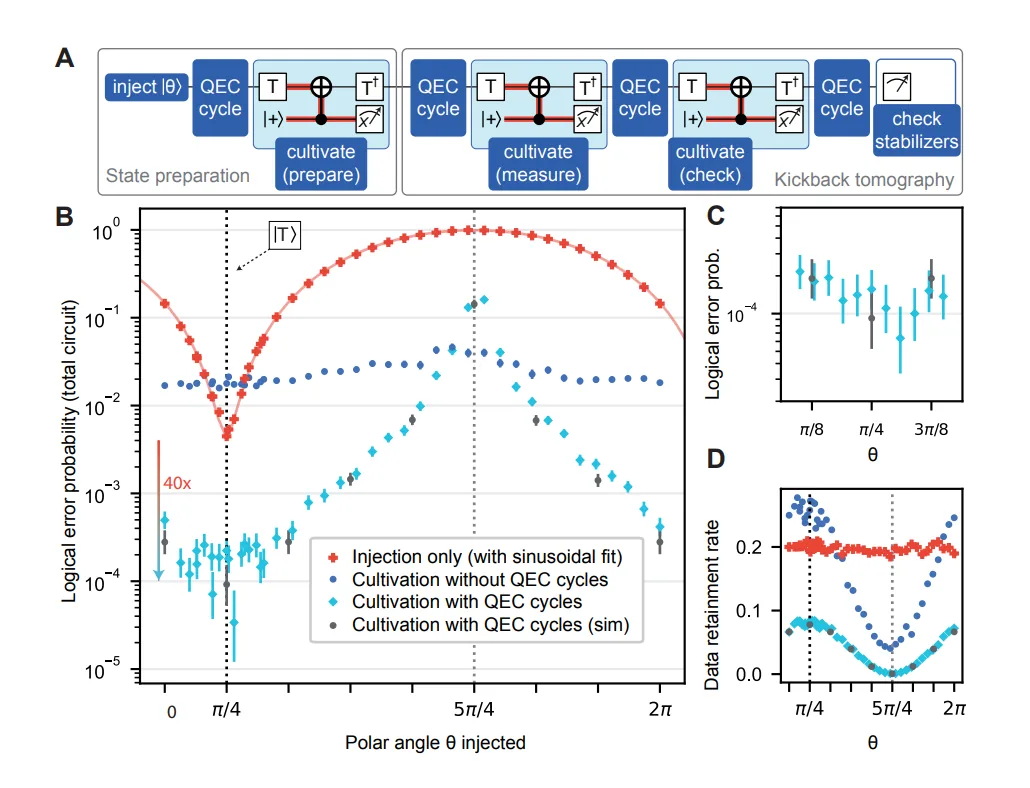
Google Quantum AI reported in the journal Science the first hardware demonstration of "magic state cultivation" on its Willow processor, reducing errors for prepared quantum states by roughly 40 times and achieving 99.99% logical fidelity. The technique discards failing states while they are still small, using no more than 54 of Willow's 105 qubits. Google says the method must still be validated at larger scale, but if it scales, it could reduce the hardware needed for useful, error-corrected quantum computers.
 Reference image
Editorial responsibility
- No named human review is recorded for this page.
- Reports are grouped by semantic similarity and deterministic rules. Language models may assist titles, summaries, translation and cross-source analysis; the page reads the event directly, while its address stays stable when the title changes.
- Summary covers the current reports
Cross-source coverage
Reporting timeline
Google Demonstrates Cheaper Magic-State Method on Willow Quantum Chip
Google researchers reported in the journal Science the first hardware demonstration of a cheaper approach to producing "magic states," the consumable fuel quantum computers need to run useful computations. For two decades, standard distillation refineries consumed up to 95% of a machine, leaving roughly 5% to compute. The new method instead starts one rough magic state in a small chip region and checks it, discarding failures while they are still tiny; about 92 of every 100 attempts are thrown away at little cost. Using no more than 54 of the 105 qubits on Google's Willow chip, the states that passed had roughly 40x fewer errors than those skipping the process, a 99.99% figure. Researcher Emma Rosenfeld spent months on results that appeared to violate physics before the team traced the problem to electrical drift and temperature swings and used the verification step itself as the measurement tool. Google says it must still prove the method at larger scale; if it does, estimates of the size and timelines for useful quantum computers could shrink.
Read sourceGoogle Reports Quantum State Breakthrough on Willow Processor With 99.99% Fidelity
Google has demonstrated a quantum computing advance on its Willow processor, according to a post circulating on X. Researchers report producing essential quantum states with roughly 40× lower error than preparation without "magic state cultivation," reaching approximately 99.99% fidelity. These states are consumed during computation, and producing enough reliable ones is described as one of the biggest resource bottlenecks in building useful, error-corrected quantum computers. Google has now demonstrated on hardware a method designed to reduce that problem. The post notes the potential significance for science: calculating how electrons interact in complex molecules and materials, helping researchers investigate chemical reactions, catalysts and properties that remain difficult to model accurately with classical computers.
Read sourceGoogle Researchers Demonstrate Magic State Cultivation on Willow Processor
Researchers demonstrated a technique called magic state cultivation on Google's Willow processor, reducing errors by 40x and achieving 99.99% logical fidelity, according to a post describing the result. Producing high-quality magic states is described as one of the hardest and biggest bottlenecks in building fault-tolerant quantum computers, with some estimates suggesting up to 95% of a quantum computer's resources could be dedicated to generating them. The post says Google experimentally demonstrated a way to purify those states using coordinated error-detection measurements and to transfer them between different quantum error-correcting codes. The technique still needs to be scaled up, but if it is, it could significantly reduce the hardware required to build useful quantum computers.
Read sourceShow 2 older updatesHide older updates
Google Claims Quantum Chip Breakthrough with 40x Error Reduction
Google announced on October 15 that its Quantum AI team validated a technique called "Magic State Cultivation" on the Willow quantum chip, reducing error rates for specific quantum states by approximately 40 times and achieving 99.99% accuracy. The research was published in the journal Science. Google explained that quantum computers are prone to interference errors, and preparing special quantum states for complex calculations is resource-intensive, with some estimates suggesting traditional methods may consume up to 95% of a quantum computer's processing power. The new technique detects and removes erroneous quantum states, improving preparation efficiency and potentially reducing future error-correction resource consumption. Google stated this is an important step toward practical quantum computing but further validation is needed for larger-scale systems.
Read sourceGoogle Quantum AI Demonstrates Magic State Cultivation With 40x Error Reduction
Sundar Pichai announced that Google Quantum AI has demonstrated "magic state cultivation" on physical hardware for the first time. According to the post, the result is a 40x error reduction on the Willow processor compared with previous methods, achieving a state-of-the-art 99.99% logical fidelity. Pichai described it as another step toward useful, error-corrected quantum computers that could help solve the hardest problems. The result was published in Science on the day of the post, and a video was offered to show how it works.