G20 hosts cancel family photo after allies refuse to pose with Lavrov
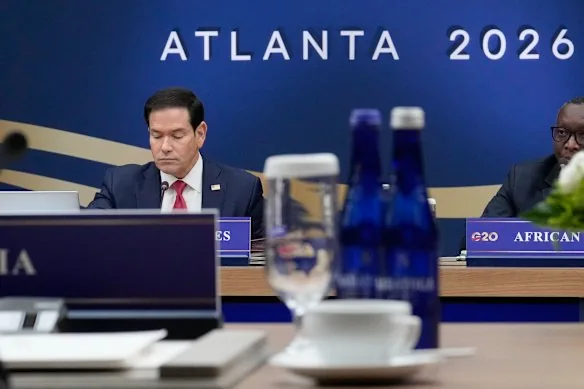
The United States cancelled the traditional G20 "family photo" at a foreign ministers' meeting in Atlanta after European delegations, including the UK, along with Australia and others, refused to appear alongside Russian Foreign Minister Sergey Lavrov. Two officials confirmed the cancellation to the BBC, and a US official said the photo was dropped to avoid a "diplomatic distraction." The meeting, hosted by Secretary of State Marco Rubio, covers Russia's war in Ukraine, the US-Israeli war against Iran, tariffs and China's conduct in the South China Sea. Ukraine and South Africa were not invited.
 Reference image
Editorial responsibility
- No named human review is recorded for this page.
- Reports are grouped by semantic similarity and deterministic rules. Language models may assist titles, summaries, translation and cross-source analysis; the page reads the event directly, while its address stays stable when the title changes.
- Summary covers the current reports
Cross-source coverage
Reporting timeline
US cancels G20 family photo after allies refuse to appear with Russia
The United States canceled the traditional G20 'family photo' at a foreign ministers' meeting in Atlanta after Australia, the United Kingdom and other delegations refused to appear alongside Russian Foreign Minister Sergey Lavrov, according to The Guardian, The New York Times and CNN. The New York Times reported that distaste for Lavrov forced the U.S. to scrap the photo session. CNN described the cancellation as stemming from tensions over the Russian foreign minister's presence. Separately, PBS reported that Secretary of State Marco Rubio welcomed G20 foreign ministers to Atlanta at what he called a 'critical moment,' while The Atlanta Journal-Constitution noted the summit's traffic and economic impact on the city. The reports attribute the cancellation to allied objections to Lavrov's participation rather than to a single official U.S. statement.
Read sourceG20 foreign ministers cancel group photo after Europeans refuse to appear with Lavrov
G20 foreign ministers meeting in Atlanta cancelled the traditional 'family photo' after European delegations, along with Australia, the UK and others, refused to appear alongside Russian Foreign Minister Sergey Lavrov. The US, which hosted the meeting, dropped the group photo session. Multiple outlets including Al Jazeera, The Guardian, The New York Times, Reuters and BBC reported that the decision followed objections over Lavrov's presence, reflecting continued diplomatic isolation of Russia over its war in Ukraine. No further details on the discussions or outcomes of the ministerial meeting were provided in the aggregated headlines.
Read sourceG20 family photo cancelled as European ministers refuse to pose with Lavrov
European diplomats refused to stand for the traditional G20 'family photo' with Russian Foreign Minister Sergei Lavrov at the G20 Foreign Ministers' Meeting hosted by US Secretary of State Marco Rubio in Atlanta, prompting the American hosts to cancel the planned picture. Two officials confirmed the cancellation to the BBC. British Foreign Secretary Ed Miliband was among those present, and a UK official said Britain has a longstanding policy of no direct bilateral engagement with Russian ministers since the invasion of Ukraine. A US official said the photo was scrapped to avoid a 'diplomatic distraction' and keep focus on substantive discussions. Ukraine, which is not a G20 member but has been invited to similar meetings in recent years, was not invited this time. The snub comes amid tense Ukraine-US relations and a partial thaw between Washington and Moscow, after President Trump waived some sanctions and agreed a deal to import Russian diesel.
Read sourceShow 2 older updatesHide older updates
G-20 Foreign Ministers Cancel Group Photo After Europeans Refuse to Pose With Lavrov
The group photo at the G-20 foreign ministers' meeting in Atlanta was canceled after several European participants threatened to walk out rather than appear alongside Russian Foreign Minister Sergey Lavrov. Host and US Secretary of State Marco Rubio decided Thursday evening to drop the photo because the dispute would be a distraction, according to two anonymous US officials. The meeting on Friday and Saturday in Georgia gathers top diplomats from most of the world's largest economies, including Russia and China, with agenda items including Russia's war against Ukraine, the US-Israeli war against Iran, US tariffs, and China's conduct in the South China Sea. Unlike previous G-20 meetings, Ukraine was not invited this year, nor was South Africa, the only African G-20 member, which is in a bitter dispute with the Trump administration. Former US ambassador to Georgia Ian Kelly said Lavrov's presence could hurt Trump domestically before Tuesday's congressional elections and would at least anger Western participants, calling the invitation 'politically dumb.' The ministers are preparing for the G-20 leaders' summit in December at Trump's Miami golf course; it remains unclear whether Vladimir Putin will accept the invitation.
Read sourceLavrov's U.S. G20 Visit Draws Bipartisan and Allied Backlash
Russian Foreign Minister Sergey Lavrov arrived in Atlanta for a G20 foreign ministers' meeting, drawing backlash from U.S. lawmakers and allied diplomats. Lavrov is the highest-profile Russian official to visit the U.S. since Russia's 2022 invasion of Ukraine. European leaders refused to stand next to him, forcing Secretary of State Marco Rubio to scrap the traditional group photo. Republican Representative Don Bacon said Lavrov should not be allowed into the country, calling Russia a pariah state. A bipartisan group of 13 senators on the Foreign Relations Committee condemned the invitation in a joint letter, warning it risks legitimizing a government that continues to attack Ukrainian civilian targets. Meanwhile, South Africa, a G20 founding member, did not attend amid disputes with the Trump administration, and its spokesperson said nonparticipation was not voluntary. The article argues the administration is forcing other countries to deal with Russia while Putin refuses concessions.