Belgian physicist Francis Halzen wins 2026 Nobel Prize in Physics for IceCube neutrino work
Belgian-American physicist Francis Halzen has won the 2026 Nobel Prize in Physics for his decisive contributions to the IceCube Neutrino Observatory and the discovery of high-energy neutrinos of astrophysical origin. The Royal Swedish Academy of Sciences announced the award on October 6, 2026, in Stockholm. Halzen recognized that Antarctic ice could be used to track neutrinos, also known as ghost particles. The prize is endowed with 12 million Swedish kronor (approximately one million euros).
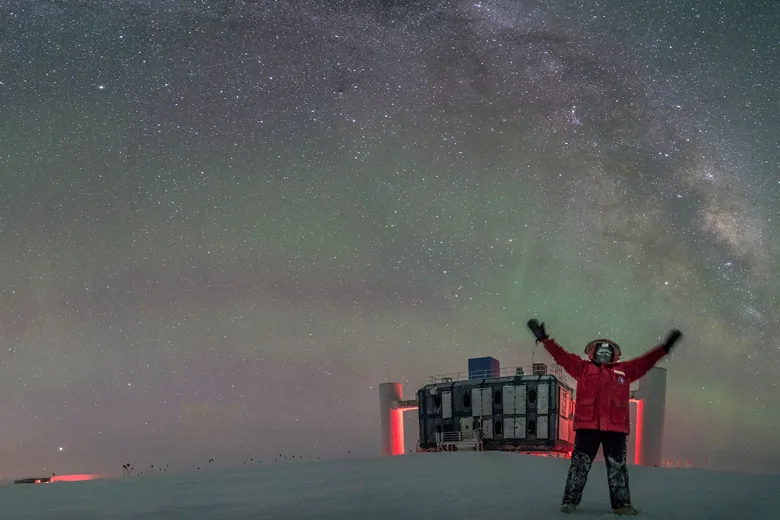 Reference image
Editorial responsibility
- No named human review is recorded for this page.
- Reports are grouped by semantic similarity and deterministic rules. Language models may assist titles, summaries, translation and cross-source analysis; the page reads the event directly, while its address stays stable when the title changes.
- Summary covers the current reports
Cross-source coverage
Reporting timeline
Belgian physicist Francis Halzen wins 2026 Nobel Prize in Physics for IceCube neutrino observatory
Belgian physicist Prof Francis Halzen has won the 2026 Nobel Prize in Physics for his pioneering work on the IceCube Neutrino Observatory at the South Pole. The Royal Swedish Academy of Sciences awarded the prize for his 'decisive contribution' to developing the observatory, which uses a cubic kilometre of Antarctic ice fitted with light sensors to detect elusive subatomic particles called neutrinos. These 'ghost particles' carry information about violent, high-energy processes in distant galaxies, allowing scientists to investigate places ordinary telescopes cannot easily see. Mark Pearce, Chair of the Nobel Committee for Physics, stated that Halzen's 'tenacity and scientific vision has paved the way for a new kind of astronomy.' Halzen first presented his vision for detecting neutrinos at the South Pole in 1988 and has since led an international team of researchers and engineers.
Read source2026 Nobel Prize in Physics Awarded to Belgian Astrophysicist Francis Halzen for Neutrino Research
The 2026 Nobel Prize in Physics has been awarded to Belgian-American astrophysicist Francis Halzen for his decisive contributions to the IceCube Neutrino Observatory and the discovery of high-energy neutrinos of astrophysical origin. The announcement was made by the Royal Swedish Academy of Sciences in Stockholm on October 6, 2026. Halzen's work has been instrumental in advancing the field of neutrino astronomy, enabling the detection of cosmic neutrinos that provide new insights into the universe's most energetic phenomena. The award follows the announcement of the Nobel Prize in Medicine, which was awarded to German researchers Peter Hegemann and Georg Nagel, along with American Karl Deisseroth, for their method enabling deep brain exploration. The article, published by taz.de, also references the Alternative Nobel Prize awarded to computer scientist Timnit Gebru for advocating for non-corporate AI technology, and other initiatives in Georgia, Pakistan, the USA, and southern Africa.
Read sourceBelgian Astrophysicist Francis Halzen Wins 2026 Nobel Prize in Physics for Neutrino Discovery
The 2026 Nobel Prize in Physics has been awarded to Belgian-American astrophysicist Francis Halzen for his decisive contributions to the IceCube Neutrino Observatory and the discovery of high-energy neutrinos of astrophysical origin. The Royal Swedish Academy of Sciences announced the prize on October 6, 2026. Halzen, a researcher at the University of Wisconsin-Madison, recognized that Antarctic ice could be used to track neutrinos, also known as ghost particles. His vision and scientific leadership were fundamental to IceCube, a cubic kilometer of ice equipped with sensors that detect neutrinos from extremely energetic processes in the distant universe. The prize is endowed with 12 million Swedish kronor (approximately one million euros), an increase from previous years to mark the 125th anniversary of the Nobel Prize. This year also marks a historic first: Ellen Moons, a Belgian-born woman, announced the laureates as the new Secretary General of the Academy. The article also notes that the 2025 Physics Nobel was awarded to quantum researchers John Clarke, Michel Devoret, and John Martinis.
Read sourceShow 2 older updatesHide older updates
Physics Nobel Prize Awarded to Belgian-American 'Ghost Particle' Researcher Francis Halzen
The 2026 Nobel Prize in Physics has been awarded to Belgian-American particle researcher Francis Halzen for his decisive contributions to the IceCube neutrino observatory and the discovery of high-energy neutrinos of astrophysical origin. The Royal Swedish Academy of Sciences announced the award in Stockholm. Halzen recognized that the ice at the South Pole could be used to track neutrinos, also known as 'ghost particles.' His vision and scientific leadership were fundamental to IceCube, a cubic kilometer of ice equipped with sensors that allows researchers to detect neutrinos from extremely energetic processes in the distant universe. Neutrinos have no electrical charge and almost no mass, reacting very weakly with normal matter, making them extremely difficult to detect. The Nobel Committee chairman, Mark Pearce, described a neutrino as a ghostly messenger from space. The prize is endowed with 12 million Swedish kronor (approximately one million euros), following a recent increase by the Nobel Foundation to mark the 125th anniversary of the Nobel Prize.
Read source2026 Nobel Prize in Physics Awarded to Astrophysicist Francis Halzen
The 2026 Nobel Prize in Physics has been awarded to Belgian-American physicist Francis Halzen, as announced by the Royal Swedish Academy of Sciences. Halzen is recognized for his decisive contributions to the IceCube Neutrino Observatory and the discovery of high-energy neutrinos of astrophysical origin. The IceCube Observatory, located at the South Pole, detects neutrinos—nearly massless subatomic particles—from cosmic sources, opening a new window on the universe. The award highlights Halzen's leadership in the project, which has transformed neutrino astronomy. The announcement was made on October 6, 2026, and was reported by the German news outlet Die Welt. Further details are expected shortly.
Read source