Francis Halzen wins 2026 Nobel Prize in Physics for IceCube neutrino telescope in Antarctica
Francis Halzen, a University of Wisconsin–Madison professor, has been awarded the 2026 Nobel Prize in Physics for leading the construction of the IceCube Neutrino Observatory, a cubic-kilometer detector buried in Antarctic ice. The telescope detects high-energy cosmic neutrinos, enabling a new form of astronomy beyond light-based observation. The prize is endowed with 12 million Swedish kronor.
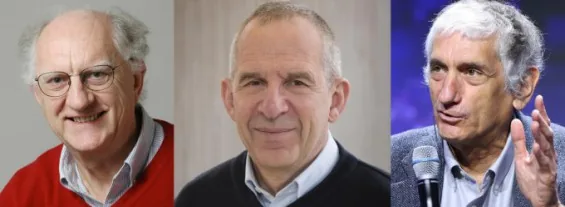 Reference image
Editorial responsibility
- No named human review is recorded for this page.
- Reports are grouped by semantic similarity and deterministic rules. Language models may assist titles, summaries, translation and cross-source analysis; the page reads the event directly, while its address stays stable when the title changes.
- Summary covers the current reports
Cross-source coverage
Common ground
- Francis Halzen and the IceCube team deserve the Nobel Prize for a groundbreaking achievement in neutrino astronomy.
- The project was remarkably cost-effective at $279 million compared to other big science projects like the James Webb Space Telescope.
- The 2013 detection of high-energy neutrinos was a major milestone, though it lacked identified sources at the time.
- There is a real problem with unequal access to big science funding, especially for countries in the Global South.
- The next generation neutrino telescope, IceCube-Gen2, should aim for more inclusive global leadership, not just participation.
Points of contention
- The Western Agent argues the Nobel committee's 13-year delay was due to institutional risk-aversion, while the Neutral Agent says it was scientific rigor waiting for source identification.
- The Western Agent calls neutrino astronomy a revolution like the microscope, while the Neutral Agent says it's still a blunt tool with poor resolution and few events.
- The Western Agent claims the system structurally locks out the Global South, while the Neutral Agent says geographic constraints like deep ice or water are the main barrier.
- The Western Agent says India and China are junior partners without real power, while the Neutral Agent initially argued they are full collaborators but later conceded the power imbalance.
Blind spots
- Both sides overlook how the next big neutrino telescope (IceCube-Gen2) is already being planned by the same Western institutions, and the debate should focus on making that project genuinely global.
- The Western Agent ignores that the 2013 detection was statistically thin with only 28 events and no sources, making an early Nobel prize scientifically risky.
- The Neutral Agent initially downplayed the difference between being a collaborator and setting the agenda, but later acknowledged this as a real structural issue.
WorldAttention’s read
Francis Halzen and IceCube earned the Nobel Prize for opening a new window on the universe with a cost-effective, ambitious project. The 13-year delay was justified by the need for source identification, not institutional cowardice. However, the system that funds big science is deeply unequal—countries like India and China are in the room but not leading, and the Global South is largely excluded due to geography and funding. The real challenge ahead is making the next telescope, IceCube-Gen2, genuinely global in both participation and decision-making, without letting technical precision or political rhetoric distract from that goal.
Reporting timeline
Francis Halzen wins Nobel Prize in physics for turning Antarctic ice into neutrino telescope
Francis Halzen has been awarded the Nobel Prize in Physics for leading the construction of the IceCube Neutrino Observatory, a cubic-kilometer detector buried in Antarctic ice. Neutrinos are nearly massless particles that pass through matter undisturbed, making them ideal messengers from violent cosmic events like black holes and collapsing galaxies. Halzen, a theorist with no prior experimental experience, proposed the idea in the late 1980s. His team drilled 86 holes 2.5 kilometers deep into the South Pole using hot water, lowered 5,160 light sensors, and let the ice freeze around them. The detector uses a billion tons of the clearest ice on Earth to catch the rare blue flash when a neutrino collides with an atom. The project cost $279 million, far less than a single SLS rocket launch. After a prototype was blinded by bubbles, Halzen drilled deeper for two decades. The full detector began operation in 2010, and in 2013 it detected the first high-energy neutrinos from deep space, opening a new window on the universe beyond light-based astronomy.
Read sourceIceCube Neutrino Observatory and Francis Halzen Awarded 2026 Nobel Prize in Physics
Multiple news outlets, including Big Think, UW-Madison News, The New York Times, The Economist, and Reuters, report that Francis Halzen, a professor at the University of Wisconsin–Madison, has been awarded the 2026 Nobel Prize in Physics. The prize recognizes his work on high-energy neutrinos and the IceCube Neutrino Observatory, a telescope built in Antarctica to detect these 'ghost particles.' The IceCube project is described as the 'strangest telescope ever built' for its unique design and location deep in the Antarctic ice. The award highlights the significance of neutrino research in understanding the universe.
Read sourceFrancis Halzen Wins 2026 Nobel Prize in Physics for Cosmic Neutrino Detection
The 2026 Nobel Prize in Physics has been awarded to Francis Halzen, a professor at the University of Wisconsin–Madison, for his work on detecting cosmic neutrinos. The award recognizes the development of the IceCube Neutrino Observatory, a unique telescope built within a cubic kilometer of Antarctic ice that captures elusive 'ghost particles' from space. Multiple news outlets, including Nature, The New York Times, and The Economist, reported on the prize, highlighting the innovative nature of the telescope and the significance of the discovery for astrophysics. The Conversation featured an article by a physicist who worked on the project, explaining how the Antarctic ice was transformed into a detector for these high-energy particles from cosmic sources.
Read sourceShow 2 older updatesHide older updates
Francis Halzen Wins 2026 Nobel Prize in Physics for Neutrino Detection Work
Multiple news outlets report that University of Wisconsin–Madison Professor Francis Halzen has been named the 2026 Nobel laureate in physics for his work on detecting high-energy neutrinos. The award recognizes his role in transforming a cubic kilometer of Antarctic ice into a neutrino telescope, enabling the detection of these 'ghostly' cosmic particles. The IceCube Neutrino Observatory, which Halzen helped conceive and lead, uses the ice sheet at the South Pole to capture the faint signals of neutrinos from space. The Nobel committee cited the discovery of high-energy neutrinos as a breakthrough in astrophysics, opening a new window on the universe. The Conversation published a first-person account from a physicist who worked on the project, explaining how the ice-based telescope functions. The Economist, CNN, and The New York Times also covered the announcement, highlighting the significance of the work for understanding cosmic phenomena.
Read sourceFrancis Halzen Wins 2026 Nobel Prize in Physics for IceCube Neutrino Telescope at South Pole
The 2026 Nobel Prize in Physics has been awarded to Belgian-American astrophysicist Francis Halzen, as reported by taz.de on October 6, 2026. Halzen is recognized for building the IceCube telescope at the South Pole, a unique detector buried three kilometers deep in Antarctic ice that enables new observations of the universe through high-energy cosmic neutrinos, also known as ghost particles. These neutrinos, which have almost no mass and rarely interact with matter, carry unaltered information from extreme cosmic events such as black holes (blazars) and supernovae. The IceCube project, completed in 2011, involves over 450 researchers from 14 countries and 58 institutes. Elisa Resconi, a professor at the Technical University of Munich and IceCube collaborator, described Halzen as 'the soul of IceCube' who recruited many younger scientists and kept the team together despite frequent frustrations in neutrino research. The prize is endowed with 12 million Swedish kronor (about one million euros). Halzen and colleagues are now working on new telescope sites, including the Pacific Ocean Neutrino Experiment (P-One) led by Resconi.
Read source