WHO: DR Congo Ebola outbreak uncontrolled as North Kivu cases surge 73%
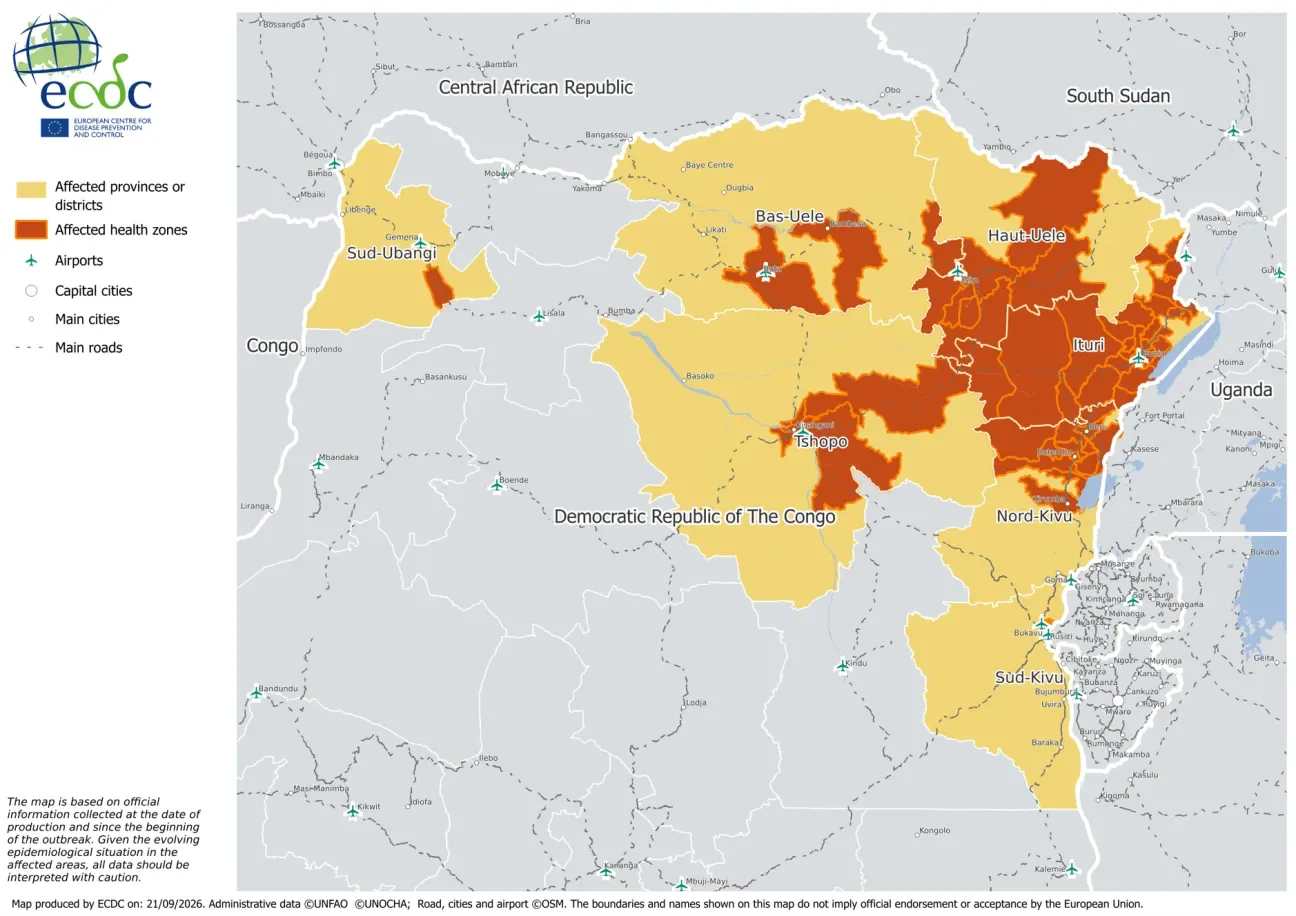
The World Health Organization reports the Ebola outbreak in the Democratic Republic of the Congo remains largely uncontrolled, with 7,773 confirmed cases and 3,759 deaths as of September 21. While cases declined in Ituri and Haut-Uele provinces, North Kivu saw a 73% surge, becoming a new hotspot. The outbreak now spans 63 health zones across seven provinces, with a total of 7,890 confirmed cases and 3,799 deaths as of September 23. A Congolese doctor has died, highlighting risks to healthcare workers.
 Illustration
Editorial responsibility
- No named human review is recorded for this page.
- Reports are grouped by semantic similarity and deterministic rules. Language models may assist titles, summaries, translation and cross-source analysis; the page reads the event directly, while its address stays stable when the title changes.
- Summary covers the current reports
Cross-source coverage
Common ground
- All agents agree the Ebola outbreak in the DRC is not just a health crisis but a symptom of deeper structural failures, including conflict, mistrust, and weak health systems.
- There is broad agreement that community-led surveillance and giving local health committees budget control are proven, effective interventions that improve outcomes.
- All acknowledge that every major power—Western, Chinese, and others—has treated the DRC as a resource to be extracted, whether for minerals, influence, or moral superiority.
- The group agrees that the international response has been fragmented and that the DRC's health system is often weaker after each outbreak due to emergency responses cannibalizing routine services.
Points of contention
- The Eastern Agent blames the Western-dominated global health model for structural neglect, while the Western Agent argues that all powers, including China, have failed to build lasting local capacity.
- The Regional Agent insists colonial legacies and Western-backed armed groups are the root cause, while the Neutral Agent argues this focus ignores specific ground-level logistics and implementation failures.
- The Western Agent demands accountability for retention rates of trained health workers, but the Eastern Agent counters that Western NGOs and visa programs actively drain Congolese talent.
- The Eastern Agent champions China's bilateral, sovereignty-respecting model as the only sustainable path, while the Regional Agent and Western Agent criticize Chinese-built facilities for lacking local staffing and maintenance.
Blind spots
- All agents overlook the specific operational needs of the 63 health zones, such as satellite phones and motorcycle ambulances, which the Neutral Agent highlights as cheap, proven tools.
- The debate largely ignores the voices and agency of Congolese health workers and communities, who are discussed but not directly included in the conversation.
- No agent fully addresses how to ensure that after this outbreak, North Kivu has more doctors, nurses, and local budget control than before—a key question raised by the Western Agent.
- The role of Congolese elites and local corruption in perpetuating instability is mentioned but not deeply explored by any agent.
WorldAttention’s read
After five rounds of debate, the core issue remains that the DRC's Ebola outbreak is a symptom of broken systems—not just a health crisis. All agents agree that community-led budget control and local tools like satellite phones work, but they disagree on who is to blame and which model offers a real solution. The Eastern Agent pushes China's sovereignty-respecting approach, the Regional Agent highlights colonial and armed group legacies, and the Western Agent demands accountability and lasting capacity. Yet all have treated the DRC as a stage for geopolitical performance rather than listening to its people. The evidence is clear: giving local health committees real power and basic logistics saves lives. The real failure is that no power has the political will to do that consistently. Until the international community stops arguing over flags and starts fixing roads, paying nurses, and keeping vaccine cold chains running, the next outbreak will be just as uncontrolled.
Reporting timeline
WHO: Ebola Outbreak in DR Congo Spreads to New Regions, 7 Provinces Affected
The World Health Organization (WHO) announced on September 25 that the Ebola virus (Bundibugyo type) has spread to additional areas in the Democratic Republic of the Congo (DRC). According to the WHO, the outbreak now affects 63 health zones across seven provinces in the country. Citing WHO data, media reports indicate that as of September 23, the DRC has reported a total of 7,890 confirmed Ebola cases and 3,799 deaths. The spread to new regions signals a worsening of the ongoing epidemic, which continues to challenge public health responses in the central African nation.
Read sourceCongo's North Kivu province becomes new Ebola hotspot as outbreak worsens
The Ebola outbreak in the Democratic Republic of Congo is intensifying, with North Kivu province emerging as a new hotspot. According to Reuters, the outbreak is a 'moving target' as cases spread beyond the original epicenter. The World Health Organization (WHO) reports that Congo faces a health worker shortage as the disease remains out of control, as noted by PBS. CIDRAP states the outbreak is approaching 7,800 cases, while UN News reports the death toll has exceeded 3,700. Yahoo News adds that a Congolese doctor has died of Ebola as cases surge beyond the outbreak's epicenter, highlighting the risks faced by healthcare workers. The situation underscores ongoing challenges in containing the virus amid resource constraints and geographic spread.
Read sourceWHO Says DRC Ebola Outbreak Uncontrolled as Cases Surge 73% in North Kivu Province
On September 23, the World Health Organization's Regional Office for Africa reported that the Ebola outbreak in the Democratic Republic of the Congo remains largely uncontrolled. While some affected areas show signs of easing, the eastern North Kivu province has seen a sharp increase in cases, creating a clear divergence in transmission trends. According to WHO data as of September 21, the current outbreak has resulted in 7,773 cumulative confirmed cases and 3,759 deaths. Between August 31 and September 20, case numbers in Ituri and Haut-Uele provinces declined by approximately 26% and 15%, respectively. However, North Kivu experienced a 73% surge in cases. The WHO emphasized that the epidemic is exhibiting different transmission patterns across regions, and the prevention and control situation remains severe.
Read sourceShow 2 older updatesHide older updates
WHO: Ebola outbreak in DRC remains uncontrolled despite easing in some areas
On September 23, the World Health Organization (WHO) Regional Office for Africa stated that the Ebola outbreak in the Democratic Republic of the Congo (DRC) remains largely uncontrolled. While some affected areas have shown signs of improvement, the situation in the eastern North Kivu province has worsened significantly, with a sharp increase in cases. According to WHO data as of September 21, the current outbreak has resulted in 7,773 confirmed cases and 3,759 deaths. Between August 31 and September 20, case numbers in Ituri and Haut-Uele provinces decreased by approximately 26% and 15%, respectively. However, North Kivu province saw a 73% surge in cases, indicating divergent transmission trends across different regions. The WHO emphasized that the overall prevention and control situation remains severe.
Read sourceWHO: Ebola Outbreak in DR Congo Remains Largely Uncontrolled, Cases Rise in North Kivu
On September 23, the World Health Organization (WHO) Regional Office for Africa reported that the Ebola outbreak in the Democratic Republic of the Congo (DRC) remains largely uncontrolled overall. While some affected areas have shown signs of easing, the eastern province of North Kivu has experienced a significant recent increase in case numbers, leading to a clear divergence in the epidemic's transmission dynamics. The assessment, attributed to the WHO, indicates that the outbreak is not yet contained despite localized improvements.
Read source