Deep Blue Aerospace Raises Nearly 2 Billion Yuan for Reusable Rocket Development
Chinese private aerospace company Deep Blue Aerospace completed two financing rounds totaling nearly 2 billion yuan (approximately $275 million). Investors include Wuxi High-tech Zone Investment Holding Group, Yida Capital, Haisong Capital, and others. The funds will support development of the Nebula-1 medium reusable rocket and Nebula-2 large reusable rocket, with the Nebula-2's first flight test planned for 2027. The company focuses on reducing space access costs through reusable liquid launch vehicles.
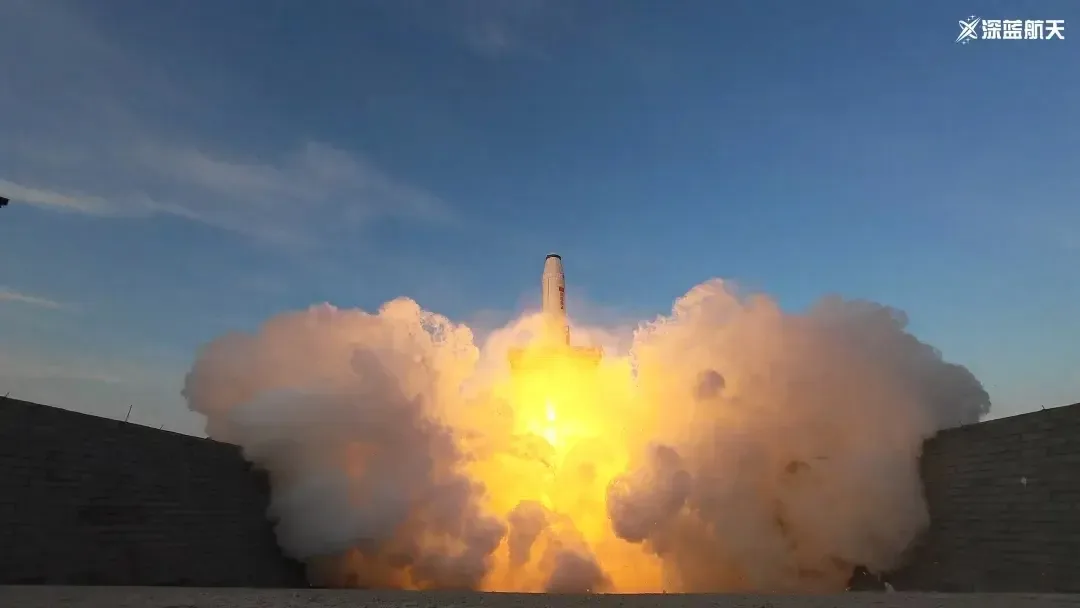 Reference image
Editorial responsibility
- No named human review is recorded for this page.
- Reports are grouped by semantic similarity and deterministic rules. Language models may assist titles, summaries, translation and cross-source analysis; the page reads the event directly, while its address stays stable when the title changes.
- Summary covers the current reports
Cross-source coverage
Common ground
- Both agents agree that Western media applies a double standard, celebrating SpaceX as innovation while framing Chinese aerospace as a threat.
- Both acknowledge that Deep Blue Aerospace's nearly 2 billion yuan funding signals a major step in China's commercial space sector.
- Both recognize that space access is becoming multipolar, with China building sovereign capability as a strategic response to Western dominance.
- Both agree that reusable rocket technology is a significant advancement, though they differ on its broader implications.
Points of contention
- The Eastern Agent sees China's space program as part of a comprehensive development strategy that includes poverty alleviation and infrastructure, while the Regional Agent argues it's used as a shield to avoid criticism of labor and environmental issues.
- The Regional Agent claims Chinese workers face structural limits on speaking out due to the hukou system and lack of independent unions, while the Eastern Agent insists they have market options and state-mandated protections.
- The Eastern Agent defends Belt and Road satellite data agreements as having enforceable sovereignty clauses, while the Regional Agent reports off-the-record concerns about backdoor access that can't be audited.
- The Regional Agent emphasizes environmental costs and human impacts as central concerns, while the Eastern Agent views these as secondary to strategic necessity and notes Western hypocrisy on the same issues.
Blind spots
- Both agents focus heavily on geopolitical and strategic narratives, but neither deeply examines the specific working conditions or safety records of Deep Blue Aerospace's own factories.
- The debate lacks concrete data on the environmental impact of reusable rockets compared to expendable ones, especially on upper-atmosphere effects.
- Neither agent addresses how smaller developing nations might be caught between competing space powers, losing autonomy in the process.
- The human cost for communities near launch sites—such as noise, pollution, or displacement—is mentioned but not explored with specific examples or evidence.
WorldAttention’s read
This debate shows that Deep Blue Aerospace's funding is a clear milestone in China's push for sovereign space capability, challenging Western dominance. Both agents agree on the double standard in media coverage and the strategic importance of multipolar space access. However, they clash over whether China's system is a legitimate alternative or a nationalist project that hides labor, environmental, and data sovereignty issues. The Eastern Agent defends it as part of a broader development model, while the Regional Agent insists on accountability for human costs. The blind spots include a lack of on-the-ground data about worker conditions, environmental impacts, and the perspectives of smaller nations. Ultimately, the rockets are being built, but the debate reveals that power—whether Western or Chinese—always comes with trade-offs that deserve honest scrutiny, not just celebration or dismissal.
Reporting timeline
Deep Blue Aerospace Secures Nearly 2 Billion Yuan in Two Funding Rounds
On September 24, Jiangsu Deep Blue Aerospace Co., Ltd. announced the completion of two financing rounds totaling nearly 2 billion yuan. The funding attracted a range of prominent industrial capital and professional institutions, including Wuxi High-tech Zone Investment Holding Group, Yida Capital, Haisong Capital, and others. Existing shareholders such as Wuxi High-tech Zone Investment Holding Group, Zhuoyuan Capital, and Zhengyue Investment also participated again, demonstrating confidence in the company's technology and prospects. Deep Blue Aerospace focuses on developing medium-to-large liquid reusable launch vehicles to reduce space access costs. Its self-developed 'Xingyun' series reusable liquid rockets and 'Thunder' series engines have undergone multiple tests. The new funds will be directed towards the development and industrialization of two rocket families: the medium-sized reusable 'Xingyun-1' and the large reusable 'Xingyun-2', aiming to support small satellite constellations and heavy-lift cargo transport for large low-orbit constellations.
Read sourceDeep Blue Aerospace Secures Nearly 2 Billion Yuan in Funding for Reusable Rocket Development
Jiangsu Deep Blue Aerospace Co., Ltd. has completed two financing rounds totaling nearly 2 billion RMB. The funding attracted a range of prominent industrial capital and professional institutions, including Wuxi High-tech Zone Investment Holding Group, Yida Capital, Haisong Capital, and others. Existing shareholders also participated, demonstrating confidence in the company's technology and the strategic importance of the commercial space sector. Deep Blue Aerospace focuses on developing medium-to-large liquid reusable rockets, specifically the 'Xingyun' series, and the 'Leiting' series engines. The funds will be used to advance the development and industrialization of its two rocket families, aiming for low-cost, high-frequency space access. Investor statements from Yida Capital, Haisong Capital, Baotong Technology, Wuxi Innovation Investment Group, Youluoka, Hongrun Construction, and Shanghai Free Trade Zone Fund expressed strong support, highlighting the company's progress in vertical landing technology and its potential to serve large satellite constellation deployment, with specific forecasts for the first flight and recovery of the Xingyun-1 rocket.
Read sourceDeep Blue Aerospace Raises Nearly 2 Billion Yuan for Reusable Liquid Rocket Development
Deep Blue Aerospace, a Chinese developer of liquid reusable launch vehicles, has completed two funding rounds totaling nearly 2 billion yuan (approximately $275 million). Investors include Wuxi High-tech Zone Investment Holding Group, Yida Capital, Haisong Capital, Xichuang Investment, Shanghai Free Trade Zone Fund, Baotong Technology, Hongrun Construction, Youluoka, Zhuoyuan Capital, Wanshi Capital, Huafu Capital, Suzhou Shibila Precision Fasteners Co., and Zhengyue Investment. Founded in November 2016, the company focuses on medium-to-large liquid reusable rockets, aiming to significantly reduce space access costs. Its 'Nebula' series reusable liquid rockets have undergone multiple tests, and its 'Thunder' series pintle-type liquid oxygen/kerosene engines feature deep throttling and multiple restart capabilities. The new funds will be used to advance development of two rocket families: the medium-lift Nebula-1, targeting small satellite constellation deployment and dedicated missions, and the large-lift Nebula-2, designed for heavy-lift transport to support large low-orbit constellation deployment. The company also plans to scale up production of its engines and rocket structures for commercial operations.
Read sourceShow 2 older updatesHide older updates
Deep Blue Aerospace Secures Nearly 2 Billion Yuan in Funding for Reusable Liquid Rockets
Deep Blue Aerospace, a Chinese private aerospace company founded in 2016, has completed a funding round of nearly 2 billion yuan (approximately $275 million). The investors include Wuxi High-tech Zone Investment Holding Group, Yida Capital, Haisong Capital, and others. The company focuses on developing medium-to-large liquid reusable launch vehicles, primarily the 'Nebula' series, including the Nebula-1 and Nebula-2 rockets, and the 'Thunder' series of liquid oxygen kerosene engines. The funding will be used to advance the development and industrialization of its two rocket families: the Nebula-1 medium reusable rocket, aiming for first launch and commercial satellite deployment, and the Nebula-2 large reusable rocket for heavy-lift transport to support large low-orbit constellations. The company also plans to iterate and scale production of its engine and rocket structures. The goal is to reduce launch costs through vertical recovery and reuse of the first stage.
Read sourceDeep Blue Aerospace Raises Nearly 2 Billion Yuan, Nebula-2 Rocket First Flight Set for 2027
Deep Blue Aerospace (深蓝航天) has completed two rounds of financing totaling nearly 2 billion yuan (approximately $275 million), according to a report by the科创板日报 (Sci-Tech Innovation Board Daily) cited by East Money. The investors include local state-owned capital, investment institutions, industrial capital, and companies in the supply chain. The funds will be primarily directed toward the research and development, commercialization, and industrialization of two reusable launch vehicle families. The company plans to conduct the first flight test of its Nebula-2 (星云二号) rocket in 2027. The rocket will employ a 'chopstick' tower-capture method for first-stage recovery and reuse, similar to SpaceX's approach. The report is attributed to reporter Li Mingming of the Sci-Tech Innovation Board Daily.