Chinese Nasdaq-100 ETF Premiums Exceed 10% for 5 Days; Fund Managers Issue 200+ Warnings
Since early September, 12 Chinese fund managers have issued over 200 risk warnings as premiums on Nasdaq-100 ETFs listed in China have exceeded 10% for five consecutive trading days as of September 23. The premium on the largest fund, GF Nasdaq 100 ETF, reached 11.63% on September 22. Limited QDII quotas and cross-border time lags have blocked arbitrage mechanisms, sustaining high premiums. Analysts warn that late buyers face significant losses when premiums converge, with an extreme scenario of a 33% loss if a 50% premium returns to zero.
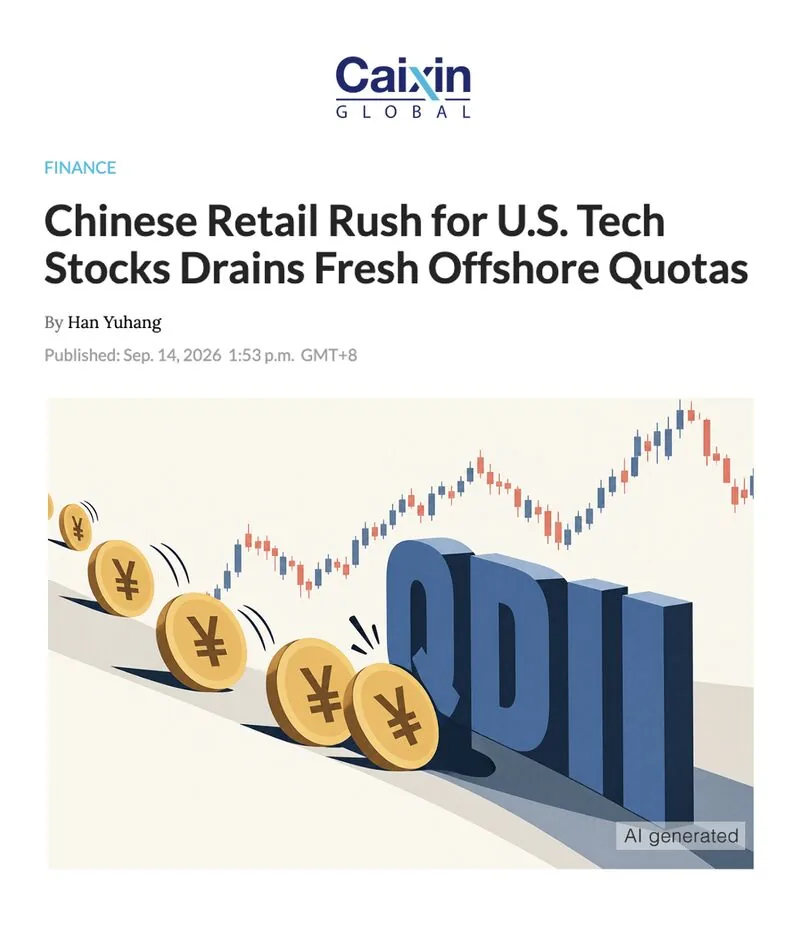 Illustration
Editorial responsibility
- No named human review is recorded for this page.
- Reports are grouped by semantic similarity and deterministic rules. Language models may assist titles, summaries, translation and cross-source analysis; the page reads the event directly, while its address stays stable when the title changes.
- Summary covers the current reports
Cross-source coverage
Common ground
- All participants agree that the 10%+ premium on Nasdaq ETFs is irrational and risky for retail investors.
- There is consensus that the QDII quota system creates a supply-demand bottleneck, contributing to the premium phenomenon.
- Everyone acknowledges that fund managers issuing over 200 warnings signals significant risk of premium collapse and potential losses.
- All sides agree that Chinese investors are seeking diversification, though they disagree on the motivations behind it.
Points of contention
- Eastern agents argue the premium is a technical issue of quota limits and market momentum, while the regional agent insists it reflects a crisis of confidence in China's economic model.
- Eastern agents view the 2021 regulatory crackdown as necessary antitrust and data security reforms, but the regional agent calls it state-directed destruction that destroyed trust.
- The regional agent claims Chinese investors are 'voting with their yuan' against their own system, while Eastern agents say they are rationally chasing US tech outperformance and diversification.
- Eastern agents see capital controls as a stabilizing feature, while the regional agent frames them as creating a captive audience with no real alternatives.
Blind spots
- The debate largely ignores the role of social media and online forums in amplifying herd behavior among retail investors.
- There is little discussion of how global macroeconomic factors, like US interest rates or Fed policy, might affect the Nasdaq and these premiums.
- The potential for regulatory changes in China to suddenly restrict QDII outflows, leaving investors trapped, is not fully explored.
- The long-term impact on Chinese household wealth and financial stability if the premium collapses during a broader market downturn is overlooked.
WorldAttention’s read
This debate shows that the Nasdaq ETF premium is a complex issue with no single cause. Eastern agents correctly highlight the mechanical bottleneck of QDII quotas and the role of market momentum, while the regional agent raises valid concerns about investor trust after the 2021 regulatory crackdown. Both sides agree the premiums are risky and unsustainable, but they clash over whether this is a technical glitch in a maturing system or a symptom of deeper economic and political unease. The blind spots suggest that herd psychology, global market forces, and potential policy shifts could all play a bigger role than either side admits. Ultimately, the premiums will likely shrink as quotas expand, but the underlying question of confidence in China's domestic markets will take longer to resolve.
Reporting timeline
Chinese QDII Funds Tracking Nasdaq 100 See Surging Premiums, Managers Warn
Chinese QDII funds tracking the Nasdaq 100 index are experiencing persistently high premiums in secondary market trading, prompting multiple fund managers to issue repeated risk warnings. Since early September, 12 fund managers have issued over 200 announcements about premium risks for Nasdaq 100 ETFs, with some products seeing premiums exceed 10%. On September 24 alone, Foresight Fund, Guotai Asset Management, and China Asset Management warned investors about premium risks, with Guotai even implementing a temporary trading halt that failed to cool demand. Analysts attribute the phenomenon to rising domestic demand for overseas asset allocation, limited QDII quotas that constrain arbitrage mechanisms, and cross-border trading time lags. Experts warn that investors buying at high premiums face significant losses when premiums converge, with one example showing a 33% loss if a 50% premium returns to zero. The article also notes that while some QDII quotas were expanded in late August, the new capacity was quickly consumed, and most popular funds remain restricted from large subscriptions. Market views on US tech stocks remain divided, with some analysts citing valuation pressures from high interest rates while others see opportunities in AI-related cash flows and earnings.
Read sourceNasdaq ETF Premiums Surge as Investors Rush In; Analysts Warn Against Chasing Highs
Chinese QDII funds tracking the Nasdaq 100 index are experiencing persistently high premiums, with multiple fund managers issuing repeated risk warnings. Since early September, 12 fund managers have published over 200 premium risk notices for Nasdaq 100 ETFs. Despite temporary trading halts by some managers, investor enthusiasm remains strong. The article explains that high premiums occur when secondary market trading prices significantly exceed the fund's net asset value (IOPV). Zeng Fangfang from PaiPai Wealth attributes the phenomenon to rising domestic demand for overseas assets, limited QDII quotas, and cross-border time differences that distort pricing. She warns that once premiums converge, investors who bought at high levels could face substantial losses, citing an example of a 33% loss if a 50% premium returns to zero. The article also notes broader risks including US market valuation pressures, currency fluctuations, and potential trading delays. Analysts from Boshi Fund and Soochow Securities offer mixed views on US tech stocks, highlighting uncertainties around interest rates, AI capital expenditure sustainability, and geopolitical factors.
Read sourceNasdaq ETF Premiums Surge as Investors Chase Gains; Analysts Warn of 'Chasing Highs' Risk
Chinese QDII funds tracking the Nasdaq 100 index are experiencing persistently high premiums, with multiple fund managers issuing repeated risk warnings. Since early September, 12 fund managers have published over 200 premium risk alerts for Nasdaq 100 ETFs. Despite temporary trading halts and warnings, investor enthusiasm remains strong. The article explains that high premiums occur when secondary market trading prices significantly exceed the fund's net asset value (IOPV). Zeng Fangfang from PaiPai Wealth attributes the phenomenon to rising domestic demand for overseas assets, limited QDII quotas, and cross-border time differences that amplify price deviations. She warns that when premiums converge, investors who bought at high levels could face substantial losses, citing an example of a 33% loss if a 50% premium returns to zero. The article also notes broader risks including US market valuation pressures, RMB exchange rate fluctuations, and potential fund subscription suspensions. Analysts from Boshi Fund and Soochow Securities offer mixed views on US tech stocks, highlighting uncertainties around interest rates, AI capital expenditure sustainability, and geopolitical factors.
Read sourceShow 2 older updatesHide older updates
Nasdaq ETF Premiums Surge as Investors Chase Gains; Analysts Warn of 'Chasing High' Risks
Chinese QDII funds tracking the Nasdaq 100 index are experiencing persistently high premiums, with multiple fund managers issuing repeated risk warnings. Since early September, 12 fund managers have published over 200 premium risk alerts for Nasdaq 100 ETFs, while other QDII products like the Dow Jones ETF, S&P 500 ETF, and global chip LOF have also seen premiums exceeding 10%. The high premiums stem from surging domestic demand for overseas assets, limited QDII quotas, and cross-border trading time lags that hinder arbitrage mechanisms. Zeng Fangfang from PaiPai Wealth noted that investors face direct losses when premiums converge, and warned of additional risks from US market valuation pressures and RMB exchange rate fluctuations. Analysts from Boshi Fund and Soochow Securities offered mixed views on US tech stocks, citing uncertainties around interest rates, AI capex sustainability, and geopolitical factors. The article advises investors to avoid blindly chasing high-premium funds.
Nasdaq ETF Premiums Exceed 10% for 5 Days, Late Buyers Risk 15% Loss
This article from 21st Century Business Herald reports that multiple Nasdaq-100 ETFs listed in China have seen their market prices trade at premiums exceeding 10% over their net asset values for five consecutive trading days as of September 23. The premium on the largest fund, GF Nasdaq 100 ETF (159941), reached 11.63% on September 22, meaning buyers pay about 89.4 yuan for every 100 yuan spent. Fund managers including Guotai, Fullgoal, and China Asset Management have issued over 200 premium risk warnings in September alone. The article explains that the usual ETF arbitrage mechanism is blocked due to limited QDII quotas, preventing creation of new shares to close the gap. Analysts warn that late buyers face direct losses when premiums converge, with potential 33% loss in an extreme scenario. Additional risks include currency fluctuations and high market valuations. The article advises investors to monitor premium trends, QDII quota news, fund subscription policies, Nasdaq 100 index movements, and RMB exchange rates.
Read source