ChatAndBuild Launches Living Brain Shared Memory Across ChatGPT, Claude and Cursor
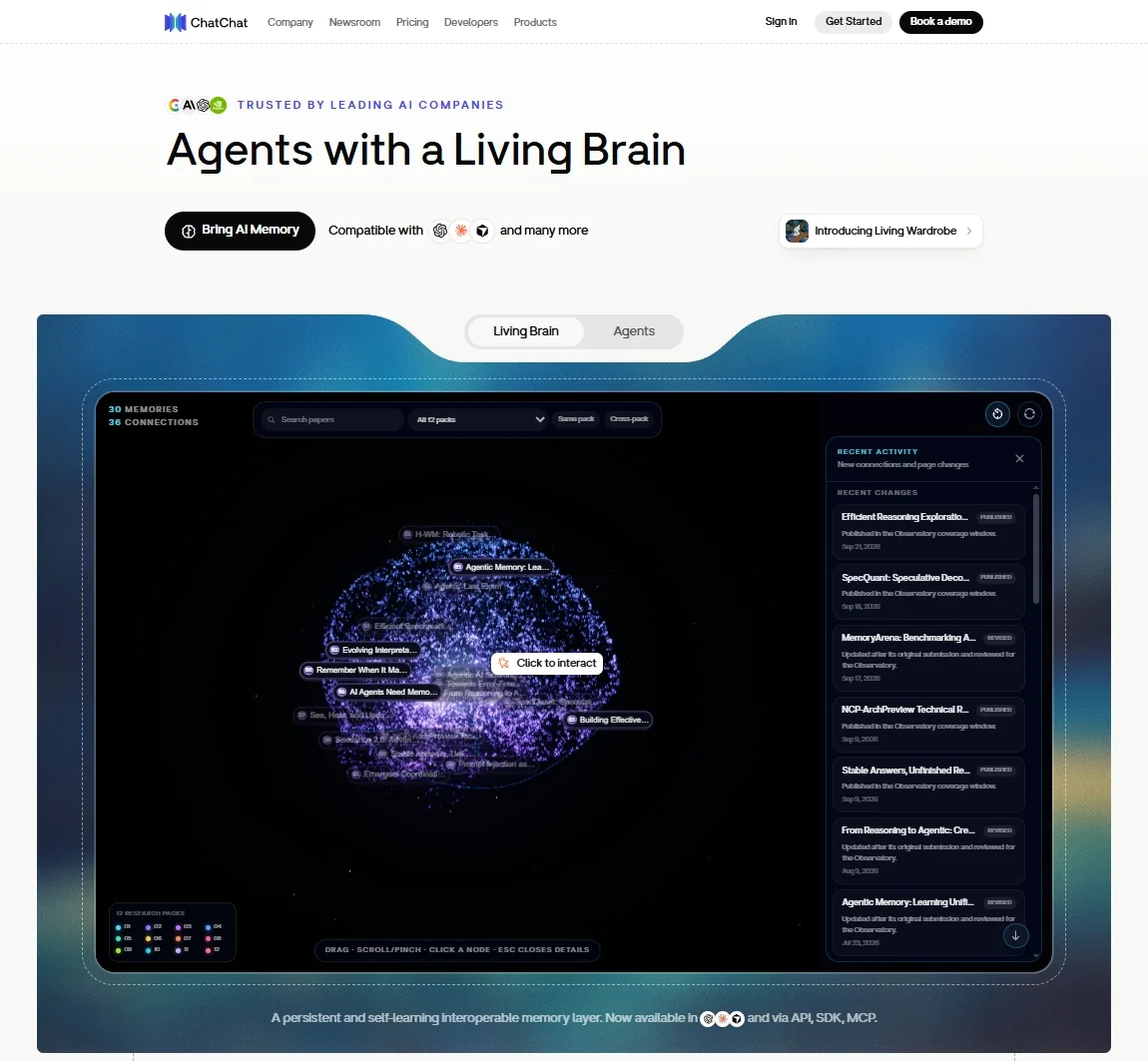
ChatAndBuild has launched Living Brain, a shared memory system that AI applications including ChatGPT, Claude and Cursor can access and edit, according to the company's announcement. Memories saved in one tool can be recalled in another, and stored pages update when something changes so connected tools work from the latest version. Living Brain also claims up to 95% lower cost per task, a 3.7s median end-to-end answer and up to 22.6x fewer tokens processed, though no pricing, availability date or independent verification was provided.
 Illustration
Editorial responsibility
- No named human review is recorded for this page.
- Reports are grouped by semantic similarity and deterministic rules. Language models may assist titles, summaries, translation and cross-source analysis; the page reads the event directly, while its address stays stable when the title changes.
- Summary covers the current reports
Cross-source coverage
Reporting timeline
LivingBrain Emerges as Cross-Model Memory Solution Spanning ChatGPT, Claude and AI Agents
Analyst commentary highlights that cross-model memory is becoming a vital topic as individuals and enterprises increasingly use more than one AI model to accomplish their work. Rather than copying context across separate systems, new solutions such as LivingBrain are emerging to provide a more seamless single memory across ChatGPT, Claude, third-party agents, and other AI actors. The post frames this as a shift away from fragmented context duplication toward unified memory shared across multiple AI tools.
ChatAndBuild Launches Living Brain Shared Memory for ChatGPT, Claude and Cursor
ChatAndBuild has launched Living Brain, a shared memory system that AI applications including ChatGPT, Claude, and Cursor can access and edit. According to the announcement, memories saved in one AI tool can be recalled in another, allowing users to switch between tools without recontextualizing. Memories and chats are stored as pages that Living Brain updates when something changes, so every connected tool works from the latest version. The post presents the launch as a way to maintain continuity across multiple AI assistants and coding tools through a single shared memory layer.
Read sourceLiving Brain Touts Shared Memory Layer for Switching AI Models Without Rebuilding Context
Living Brain is promoting a shared memory layer that spans a user's connected tools, allowing context to persist when switching between AI models. The company argues that being able to change models without rebuilding context is highly important, and that a user's context should follow them to whichever model is best suited to a given task. The post frames persistent, portable memory as a core capability of its product rather than describing a specific release, funding event, or measured result.
Read sourceShow 2 older updatesHide older updates
Living Brain Launches Persistent Memory Layer for ChatGPT, Claude, Cursor and Codex
A post attributed to user @ladyxtel announces Living Brain, described as a persistent memory system that is decoupled from any single AI model. According to the post, Living Brain serves as one shared brain for ChatGPT, Claude, Cursor, Codex and the poster's own agents, implying cross-model memory portability. The post frames the core design choice as separating memory from the underlying model, so stored context is not tied to one assistant. No pricing, availability date, technical architecture, or independent verification is provided in the source text, and the claim rests solely on the poster's announcement. The item is relevant to the AI tooling ecosystem, particularly for users who work across multiple assistants and coding agents and want continuity of context.
Living Brain Pitches Standalone AI Memory Layer With Up to 95% Lower Cost Per Task
Living Brain is positioning memory as a separate layer in the AI stack, distinct from the model that performs reasoning. The company treats AI models as swappable engines while accumulated context remains persistent, with agents connecting through MCP or an API so that changing the model or agent framework leaves memory intact. Living Brain claims up to 95% lower cost per task and a 3.7s median end-to-end answer. Rather than sending the model the entire history each time, it selects only the few stored memories relevant to the current question, reducing tokens processed by up to 22.6x. The post also notes that ChatGPT and Claude each keep private memory that neither can read from the other, while Living Brain moves memory into a separate store that both tools and users' own agents can read and write.
Read source