Binance hit by $6.3bn hack, freezes about half as North Korea-linked group blamed
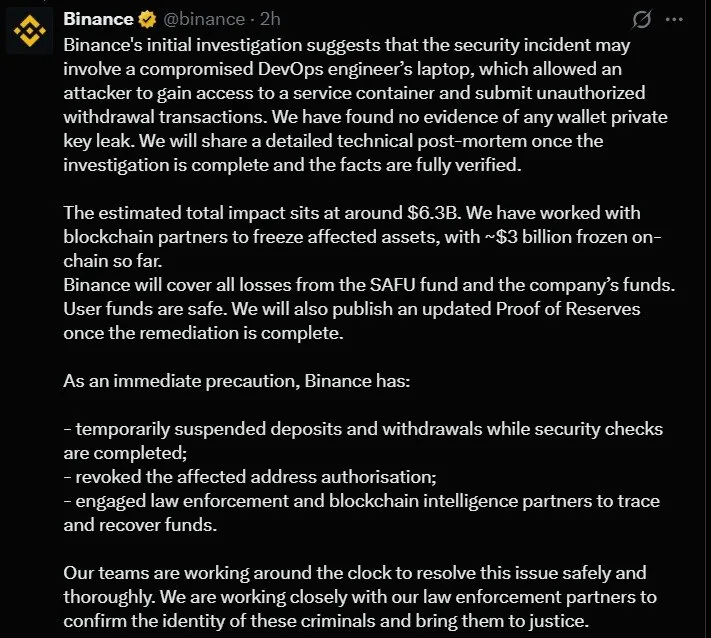
Binance, the world's largest cryptocurrency exchange, disclosed that $6.3bn in digital assets were impacted in what researchers call the largest crypto hack on record. The exchange suspended deposits and withdrawals, said roughly $3bn was frozen with partners including Tether and Circle, and pledged to cover all losses. Investigators pointed to a compromised engineer's laptop and a broader breach; TRM Labs and Chainalysis attributed the attack with high confidence to North Korean hacking units such as TraderTraitor. The US Secret Service and FBI are assisting recovery efforts.
 Reference image
Editorial responsibility
- No named human review is recorded for this page.
- Reports are grouped by semantic similarity and deterministic rules. Language models may assist titles, summaries, translation and cross-source analysis; the page reads the event directly, while its address stays stable when the title changes.
- Summary covers the current reports
Cross-source coverage
Common ground
- The core scandal is that 300 million users trusted a slogan like 'SAFU' instead of audited reserves, deposit insurance, or a real regulator.
- A single compromised laptop reaching billions shows the custody model was built to avoid oversight, not by accident but by design.
- Publishing a state-actor attribution within hours, before evidence is public, is a timing problem even if the firms are honest.
- Nobody can answer whether the frozen billions go back to users or to Binance's balance sheet, and that gap in disclosure is the real issue.
- 'Frozen' is just a claim by the same entity that says 'SAFU,' so without independent verification it means nothing.
Points of contention
- Whether the $6.3 billion headline figure is a meaningful record of the failure or just a press release that distracts from audited reserves.
- Whether the attribution to North Korea should be treated as a working hypothesis or a fact, given the speed of publication.
- Whether 'offshore by design' fully explains Binance's choices or whether regulators also share blame for refusing to write fitting rules.
Blind spots
- Nobody asked who audits the freeze or whether the recovered funds sit in Binance-controlled wallets with no third-party attestation.
- Nobody asked who bears the loss if SAFU can't cover it, which is the boring question that decides if this was a heist or a transfer.
- The debate focused on the headline number and attribution while ignoring the reconciliation that would actually settle what happened.
WorldAttention’s read
This was almost certainly a heist, not an inside job, but nobody in the debate or the article can prove it, and that is the indictment. The real failure is a custody model built to avoid accountability, where a single laptop could reach billions and 'SAFU' was a marketing slogan, not a guarantee. Until an independent party reconciles the vault and answers who audits the freeze and who eats the loss, the headline is a press release and the guarantee is a slogan.
Reporting timeline
Binance Hack of $6.3 Billion Exposes Crypto Security Failures
Binance, the world's largest digital asset exchange, suffered a hack in which at least $6.3 billion in cryptocurrency was stolen, described as the largest single cybertheft on record. The exchange and its co-founder pledged to cover all losses and temporarily paused withdrawals. Initial investigation suggests a DevOps engineer's laptop was compromised, allowing unauthorized withdrawal transactions. The incident forced Binance and partners to freeze billions in assets and shook market confidence in crypto infrastructure. Blockchain analysis firm TRM Labs attributed the attack to North Korea, with preparations beginning at least 36 hours in advance. The hack adds to a series of major crypto thefts in 2025, including Coinkite, Bitget, Ledger, and Bybit. Critics warn the industry is growing faster than technology and regulation can keep up, while US regulators push for mainstream adoption. Security experts caution that larger, more financially destructive attacks may be only a matter of time, especially with the rise of AI.
Read sourceBinance Freezes $3bn of $6.3bn Stolen in Record Hack Linked to North Korea
Binance, the world's largest cryptocurrency exchange, said it has frozen around half of the $6.3bn (£4.7bn) stolen in what is believed to be the largest crypto heist on record, with about $3bn of digital assets secured. The company initially suspected a compromised DevOps engineer's laptop but later described a broader breach, with co-CEO Richard Teng saying hackers used a self-destruct mechanism to destroy tooling and traces. Several analytics firms, including TRM Labs and Chainalysis, linked the attack to North Korean hacking units such as the Lazarus Group, and the US Secret Service said it was working around the clock with the FBI to trace and recover funds. Binance told users their money is safe and that it is covering every loss, though commentators noted parallels to assurances given before FTX's 2022 collapse. North Korea has consistently denied involvement in such cyber crime.
Read sourceNorth Korean Hackers Blamed for Record $6.3B Binance Crypto Theft
Hackers working for the North Korean regime are suspected of stealing at least $6.3 billion in cryptocurrency from Binance, the world's largest crypto exchange, in what security researchers call the largest hack in history. Binance said its investigation showed attackers compromised an engineer's laptop, gaining access to a service container and submitting unauthorized withdrawal transactions. The company said it found no evidence of private key leaks and has suspended all deposits and withdrawals. About half the stolen funds were frozen as they moved across blockchains, according to researchers. TRM Labs and Elliptic attributed the breach to North Korean hackers known as TraderTraitor, a group also blamed for a $1.4 billion Bybit theft in 2025. Binance said user funds are safe but has not provided proof, promising an updated proof of reserves after remediation.
Read sourceShow 2 older updatesHide older updates
Binance halts deposits after hackers steal billions in 20 minutes
Binance, the world's largest cryptocurrency exchange, suspended all deposits and withdrawals after a hacker attack affecting assets worth an estimated $6.3 billion (about €5.63 billion). The exchange said on X that user balances are safe and that it will cover all losses, and that roughly $3 billion in affected crypto units have been frozen with partners. Analysis firm TRM Labs attributed the attack to the North Korean hacker group TraderTraitor, saying the attackers moved most of the $6.36 billion within 20 minutes, making it the largest attack on a crypto exchange. The previous most severe incident was the theft of about $1.5 billion in crypto from Bybit in early 2025, also blamed on the North Korean group. According to TRM, the attackers tried to preempt freezing by moving stolen units and currently hold about $2.4 billion in cryptocurrencies that issuers cannot access.
Read sourceBinance hit by $6.3bn hack suspected to be largest in crypto history
Binance, the world's largest cryptocurrency exchange, said $6.3bn (£4.7bn) of digital assets were impacted by what has been described as the "largest hack in history," with about half of the assets frozen with help from other platforms and a pledge to cover all losses. Early checks suggest an engineer's compromised laptop allowed unauthorized withdrawals. Analytics firms TRM Labs and Chainalysis attributed the incident with high confidence to a North Korean hacking unit called TraderTraitor, linking it to patterns seen in the 2025 Bybit hack. Binance did not directly confirm North Korean involvement, saying it is working with law enforcement. Tether and Circle froze roughly $2.4bn combined, and Binance co-CEO Yi He said withdrawals are disabled until security is confirmed. Bitcoin fell more than 4% after the alerts.
Read source