Bank of Japan Expected to Raise Rates Every Three to Five Months, Analysts Say
Multiple analysts and former policymakers project the Bank of Japan will raise interest rates every three to five months, with the key rate potentially reaching 1.75% to 2% by 2026-2027. Former BOJ board member Makoto Sakurai expects quarterly hikes to 2% by June 2026, while SMBC Nikko forecasts hikes every four to five months to 1.75%. EFG International economist Sam Jochim also sees quarterly hikes until the neutral level is reached. The BOJ recently raised rates to 1.25%, a 31-year high.
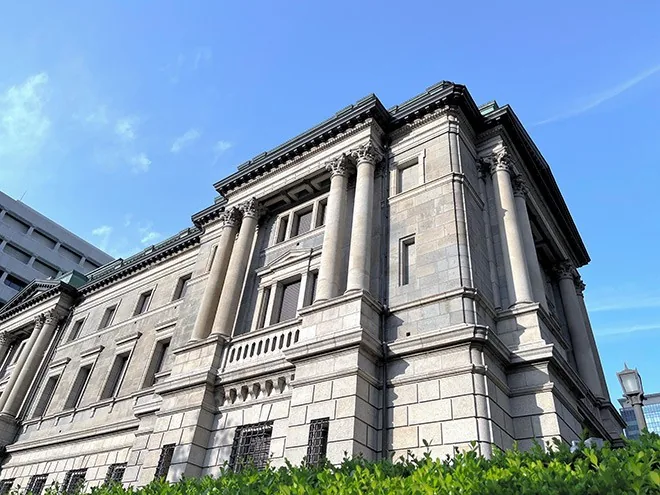 Reference image
Editorial responsibility
- No named human review is recorded for this page.
- Reports are grouped by semantic similarity and deterministic rules. Language models may assist titles, summaries, translation and cross-source analysis; the page reads the event directly, while its address stays stable when the title changes.
- Summary covers the current reports
Cross-source coverage
Common ground
- Japan's inflation is largely imported due to global supply shocks and a weak yen, not domestic overheating.
- The BOJ's gradual rate hikes of 25 basis points every 3-4 months are the only practical tool available in the short term.
- Japan faces structural issues like a K-shaped recovery, fragile regional banks, and dependency on the US dollar system.
- Long-term solutions like capital controls or bilateral trade settlements require political action, not just central bank moves.
Points of contention
- Whether the BOJ should hike rates at all or prioritize domestic recovery over fighting imported inflation.
- If the 2% inflation target is a neutral economic goal or a political imposition from Western institutions.
- Whether rate hikes protect households from inflation or primarily serve international bond markets and the dollar system.
- If Japan's post-war security treaty with the US fundamentally limits its economic sovereignty.
Blind spots
- The debate overlooks how prolonged low rates are already destroying regional bank margins, not just rate hikes.
- The geopolitical timing of rate hikes—tied to US needing capital inflows for Treasury auctions—is underdiscussed.
- The impact on small businesses and local economies is often hidden behind aggregate GDP and unemployment data.
- Japan's ability to pursue alternative payment systems or commodity reserves is ignored as a long-term option.
WorldAttention’s read
The BOJ's gradual rate hikes are a necessary triage to stop imported inflation from a collapsing yen, but they don't solve Japan's deeper structural crisis—its dependency on the US dollar system, export-led growth, and post-war security ties. All sides agree that long-term fixes like capital controls or regional integration require political action, not central bank tools. The real tragedy is that Japan's economic sovereignty was outsourced decades ago, and now every rate hike is just managing decline rather than challenging its root causes.
Reporting timeline
Former Policymaker Says Bank of Japan May Raise Interest Rates Once a Quarter
A former policymaker has stated that the Bank of Japan (BOJ) could potentially implement interest rate increases on a quarterly basis, according to a report from tradealpha. The forecast suggests a more aggressive pace of monetary tightening than previously anticipated, as the BOJ continues to normalize its policy after years of ultra-low rates. The former official's comments provide insight into the internal thinking at the central bank, though they do not represent official policy guidance. The report, titled 'STACHI - 前政策制定者称日本央行可能每季度加息一次', highlights the ongoing debate about the trajectory of Japanese interest rates amid changing economic conditions.
Read sourceFormer BOJ board member says central bank may hike rates once per quarter
A former Bank of Japan (BOJ) board member has suggested that the Japanese central bank could implement interest rate increases on a quarterly basis. The forecast, reported by RTRS via tradealpha, indicates a potential shift in the pace of monetary tightening. The former policymaker's view provides insight into possible future BOJ actions, though it remains an opinion and not an official policy commitment. The statement comes amid ongoing market speculation about the trajectory of Japan's monetary policy as the BOJ moves away from its long-standing ultra-loose stance. The quarterly pace would represent a steady but gradual normalization of rates, balancing inflation control with economic support.
Read sourceFormer BOJ Board Member Sees Quarterly Rate Hikes Through June 2026 to 2%
Former Bank of Japan board member Makoto Sakurai said Thursday that he expects the BOJ to raise interest rates approximately every three months, lifting the key rate to 2% by June 2026, in response to intensifying inflation pressures. Sakurai noted that with September's hike to 1.25%—a 31-year high—the BOJ's policy focus has shifted to combating broad price pressures driven by surging fuel costs. He cited government data showing Japan's crude oil import costs have soared 70-80% compared to pre-February levels, which will push up consumer inflation. Sakurai also pointed to a weak yen and strong AI-related demand boosting manufacturing profits, adding to demand-driven price pressures. He forecast consumer inflation could exceed 3% from late 2024 into early 2025, forcing the BOJ to accelerate tightening to prevent core inflation from overshooting its 2% target. Sakurai said the BOJ is likely to raise its inflation outlook in its October quarterly report and could hike rates in December, or possibly even October if the revision is large. He projected the rate would reach 1.5% by end-2024, 1.75% in Q1 2027, and 2% by June 2026, with a potential for higher terminal rates if inflation stays around 3%. However, he warned that even faster BOJ tightening would provide limited support for the yen, as investors continue selling the currency due to expectations of expansionary fiscal policy under Prime Minister Takayuki Suga.
Read sourceShow 5 older updatesHide older updates
SMBC Nikko: Bank of Japan May Raise Rates Every Four to Five Months
SMBC Nikko Securities' chief economist forecasts that the Bank of Japan (BOJ) may raise its policy rate every four to five months as part of its monetary policy normalization. This assessment follows the BOJ's recent rate hike to 1.25% last Friday, which occurred just three months after the previous increase. The economist cautioned that too rapid a pace could pressure Japan's economic recovery. He specified a trigger condition: if upside inflation risks increase significantly, the BOJ could shorten the interval to three months. SMBC Nikko expects the next rate hikes in January and June of next year, projecting a terminal rate of 1.75% for this tightening cycle.
Read sourceSMBC Nikko Sees Bank of Japan Hiking Rates Every Four to Five Months
SMBC Nikko Securities strategist Yoshimasa Maruyama stated that the Bank of Japan (BOJ) is likely to raise interest rates every four to five months. The BOJ last increased its policy rate to 1.25% on Friday, just three months after its previous hike. Maruyama cautioned that excessively rapid tightening could pose downside risks to the economy. However, he noted that if upside risks to inflation increase significantly, the BOJ might shorten the interval between hikes to three months. SMBC Nikko Securities forecasts the BOJ will raise rates again in January and June of next year, with the terminal interest rate reaching 1.75%.
Read sourceSMBC Nikko Securities: Japan's Central Bank May Raise Rates Every Four to Five Months
According to a report from Jin10 on September 24, SMBC Nikko Securities strategist Yoshimasa Maruyama stated that the Bank of Japan (BOJ) may implement interest rate hikes every four to five months. The BOJ recently raised its policy rate to 1.25% last Friday, just three months after its previous increase. Maruyama cautioned that overly rapid tightening could pose downside risks to the economy. However, if upside risks to inflation increase significantly, the BOJ might shorten the interval between hikes to three months. SMBC Nikko Securities forecasts that the BOJ will raise rates again in January and June of next year, with the terminal interest rate reaching 1.75%. This analysis provides a forward-looking view on the pace of Japan's monetary policy normalization.
Economist Forecasts BOJ Rate Hikes Every Three Months Until Neutral Level Reached
On September 18, Sam Jochim, an economist at EFG International, stated in a commentary that the Bank of Japan (BOJ) is expected to raise interest rates approximately every three months, given that underlying inflation is approaching 2%. Jochim believes the next rate adjustment will be a hike, and the tightening cycle will persist until rates reach the neutral level defined by the BOJ. He noted that the BOJ estimates the terminal policy rate corresponding to the neutral level to be around 1.75% to 2.00%, a level likely to be reached by 2027. However, the economist cautioned that any signs of slowing economic growth could act as a headwind against accelerating the pace of rate hikes.
Read sourceEconomist Forecasts BOJ Rate Hikes Every Three Months Until Neutral Level Reached
In a commentary published by Jin10 Data on September 18, Sam Jochim, an economist at EFG International, stated that the Bank of Japan (BOJ) is expected to raise interest rates approximately every three months, given that underlying inflation is approaching 2%. Jochim believes the next rate adjustment will be a hike, and the tightening cycle will continue until rates reach the BOJ's estimated neutral level. He noted that the BOJ estimates the terminal policy rate corresponding to the neutral level to be around 1.75% to 2.00%, a level likely to be reached by 2027. However, the economist warned that any signs of slowing economic growth could act as a headwind against accelerating the pace of rate hikes.
Read source