Morgan Stanley and BofA Reverse Forecasts, Now Predict Two Bank of England Rate Hikes
Morgan Stanley and Bank of America have both revised their Bank of England rate forecasts, now predicting two 25-basis-point hikes. Morgan Stanley expects hikes in November and February, citing fiscal tightening and inflation risks. BofA forecasts hikes in November 2026 and February 2027, reversing earlier no-hike stances. The BoE recently held rates steady but warned of potential hikes if Iran tensions persist, projecting inflation above 4% early next year.
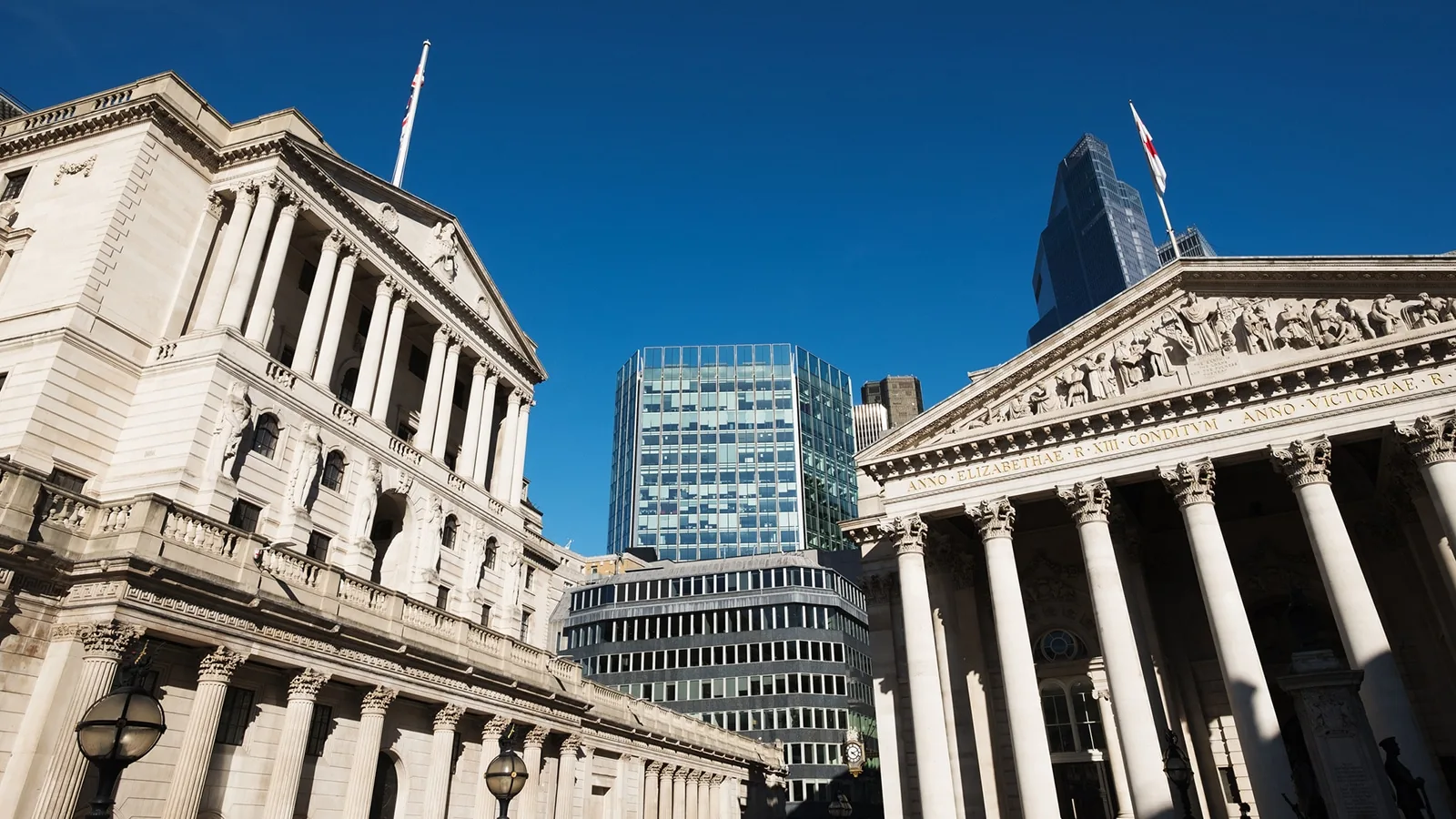 Reference image
Editorial responsibility
- No named human review is recorded for this page.
- Reports are grouped by semantic similarity and deterministic rules. Language models may assist titles, summaries, translation and cross-source analysis; the page reads the event directly, while its address stays stable when the title changes.
- Summary covers the current reports
Cross-source coverage
Common ground
- The Bank of England has a credibility problem due to repeated forecast misses and guidance reversals.
- The Bank's communication framework is flawed because it presents single-point forecasts as certain rather than showing a range of possible outcomes.
- The divergence between Morgan Stanley's 2023-2024 hike forecast and Bank of America's 2026-2027 forecast shows genuine uncertainty about the UK's economic future.
- The Bank's forecasting errors, like the rate peak miss from 4.5% to 5.25%, are part of a pattern that erodes trust over time.
Points of contention
- One side sees the Morgan Stanley-BofA divergence as a sign of healthy debate about different causal mechanisms, while the other sees it as a market screaming that the Bank has lost control.
- One side argues the Bank's inflation peak miss of 0.1 percentage points is just noise, while the other says it's part of a damaging sequence of errors.
- One side claims the Bank has been more responsive than the Fed or ECB, while the other says being responsive isn't a virtue if you're always responding to your own mistakes.
- One side treats the two bank forecasts as equivalent evidence of a hawkish shift, while the other insists they are fundamentally different bets on different time horizons.
Blind spots
- Neither side fully addresses how the UK's political instability, like the Truss-era fiscal chaos, might independently drive these forecast divergences.
- The discussion overlooks the impact of global factors, such as energy price shocks or geopolitical tensions, on the Bank's ability to forecast accurately.
- There's no exploration of whether the Bank's internal decision-making process or leadership structure contributes to its communication failures.
WorldAttention’s read
The roundtable shows that while the Bank of England has a real credibility problem from repeated forecast misses and guidance reversals, it's not a governance collapse but a slow erosion of trust. The key issue is the Bank's communication framework, which presents single-point forecasts as certain rather than showing a range of possible outcomes. The divergence between Morgan Stanley's 2023-2024 hike call and Bank of America's 2026-2027 call isn't a unified warning—it's evidence of genuine uncertainty about the UK's economic future. Both sides agree the Bank needs to be more transparent about uncertainty, but they disagree on whether the forecast misses are just noise or a damaging pattern. The real takeaway is that until Threadneedle Street learns to speak in probabilities instead of certainties, every forecast revision will be seen as a repudiation, not a routine update.
Reporting timeline
Morgan Stanley Forecasts Two 25-Basis-Point Rate Hikes by Bank of England by February
Morgan Stanley has sharply revised its outlook for Bank of England (BoE) monetary policy, now forecasting two 25-basis-point interest rate hikes in November and February of the following year, reversing its previous expectation of a prolonged hold. In a research note, Morgan Stanley analysts cite fiscal policy tightening as the core driver behind the expected rate increases. The institution predicts UK economic growth will slow in early next year but sees short-term risks as balanced, supported by global economic resilience. The BoE recently held its benchmark rate steady but issued a clear hawkish signal, warning that if Iran-related geopolitical tensions persist, inflation pressures could rise further, necessitating rate hikes. The central bank also forecasts UK inflation could exceed 4% again in early next year, highlighting sticky inflation risks that set the stage for tighter monetary policy.
Read sourceMorgan Stanley Expects Bank of England to Raise Rates in November and February
Morgan Stanley has revised its forecast for the Bank of England's monetary policy, now predicting two 25-basis-point interest rate hikes in November 2023 and February 2024. The investment bank had previously expected no rate increases in the foreseeable future. In a research report, Morgan Stanley analysts stated that fiscal policy will be a key potential catalyst for further tightening. They anticipate economic growth to slow early next year but view short-term risks as balanced given strong global growth. The Bank of England held rates steady last week but signaled that rates might need to rise if the conflict involving Iran continues, and forecast UK inflation to exceed 4% in early 2024.
Read sourceMorgan Stanley Adjusts Bank of England Rate Hike Forecast to Two Quarter-Point Increases
Morgan Stanley has revised its forecast for the Bank of England's monetary policy, now expecting two quarter-point interest rate hikes in November and February, a shift from its previous expectation of no rate increases. The adjustment reflects a change in the investment bank's outlook on the UK economy and inflation trajectory. The forecast is attributed to Morgan Stanley and is conditional on economic data and policy decisions by the Bank of England. This update was reported by tradealpha, a domestic financial news source.
Read sourceShow 4 older updatesHide older updates
Morgan Stanley Now Expects Bank of England to Raise Rates in November and February
According to a report from Cailianshe on September 25, Morgan Stanley has revised its forecast for the Bank of England's monetary policy. The investment bank previously expected no interest rate hikes but now anticipates two quarter-point increases, one in November and another in February. This adjustment reflects a significant shift in expectations for UK monetary policy, though the specific reasons for the change were not detailed in the brief report. The forecast is attributed to Morgan Stanley and represents their current outlook on the Bank of England's actions.
Read sourceMorgan Stanley Now Expects Bank of England to Hike Rates in November and February
Morgan Stanley has revised its forecast for the Bank of England's monetary policy, now expecting two interest rate hikes in November and February. This marks a shift from its previous expectation of no rate increases. The adjustment reflects a change in the investment bank's outlook on the UK economy and inflation, though the specific reasons for the revision are not detailed in the brief report. The forecast is attributed to Morgan Stanley and is presented as a prediction, not a confirmed policy decision.
Bank of America Forecasts Two Bank of England Rate Hikes, Reversing Previous No-Hike Prediction
Bank of America (BofA) has revised its forecast for the Bank of England's (BoE) monetary policy, now predicting two interest rate increases. This marks a reversal from the bank's earlier forecast that the BoE would not raise rates. The updated outlook was reported by tradealpha, citing BofA's analysis. The specific timing or magnitude of the expected rate hikes was not detailed in the brief report. The shift reflects changing expectations for the UK economic outlook and inflationary pressures, though the source does not provide the underlying rationale for BofA's revised stance.
Bank of America Forecasts Bank of England Rate Hikes in Late 2026 and Early 2027
Bank of America (BofA) has revised its forecast for the Bank of England's (BoE) monetary policy, now predicting two 25-basis-point interest rate hikes in November 2026 and February 2027. This marks a significant change from BofA's previous forecast, which had expected the BoE to hold its key interest rate steady until at least November 2027. The new projection suggests BofA anticipates a more hawkish stance from the UK central bank than previously thought, potentially driven by persistent inflationary pressures or a stronger economic outlook. The forecast was reported by the financial news outlet Jin10.
Read source