AfD's Tobias Rausch elected first far-right state parliament president in Germany
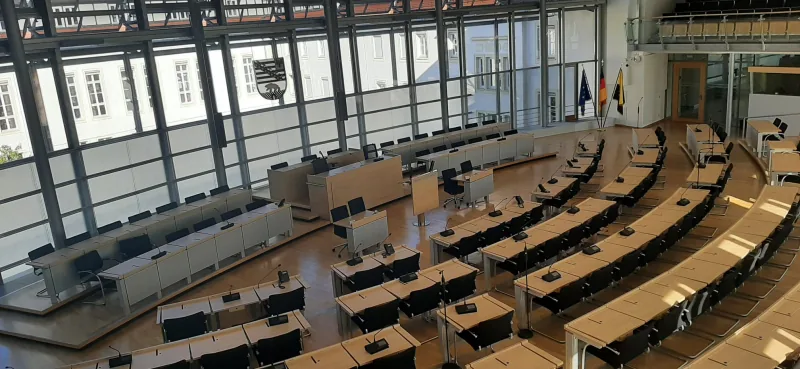
On October 6, 2026, the newly elected Saxony-Anhalt parliament in Magdeburg elected AfD politician Tobias Rausch as its president with 48 votes, four more than the combined AfD and BSW seats, marking the first time a far-right party holds a state parliament presidency in Germany. AfD hardliner Hans-Thomas Tillschneider was subsequently elected vice president with 44 votes. The results sparked sharp criticism from SPD, Greens, and Left parties, who accused the CDU of enabling the outcome through a "blue-black cartel." The BSW denied voting for Tillschneider. CDU's Thorsten Frei expressed concern over the extra votes for Rausch. Sahra Wagenknecht stated an AfD minister-president in Saxony-Anhalt has become "probable."
 Illustration
Editorial responsibility
- No named human review is recorded for this page.
- Reports are grouped by semantic similarity and deterministic rules. Language models may assist titles, summaries, translation and cross-source analysis; the page reads the event directly, while its address stays stable when the title changes.
- Summary covers the current reports
Cross-source coverage
Reporting timeline
SPD Politician Willingmann Fails in Election for State Parliament Vice President in Saxony-Anhalt
In a historic first for a German state parliament, Tobias Rausch of the far-right Alternative for Germany (AfD) was elected President of the Landtag of Saxony-Anhalt. The AfD also secured a vice-presidential post when Hans-Thomas Tillschneider was elected with 44 votes, exceeding the party's 39 seats, prompting speculation about cross-party support. The BSW party denied voting for Tillschneider. In contrast, SPD candidate Armin Willingmann failed to win a vice-presidential position, receiving only 33 votes against 48. A CDU candidate, Carsten Borchert, was later elected as a second vice president with 64 votes, reportedly including support from AfD members. The events have sparked sharp criticism from SPD, Greens, and Left parties, with some alleging a 'blue-black cartel' between the AfD and CDU. Union parliamentary group leader Thorsten Frei expressed concern over the result. Sahra Wagenknecht commented that the election makes an AfD Minister-President in Saxony-Anhalt more likely.
Read sourceAfD's Tillschneider elected vice president of Saxony-Anhalt parliament with CDU support
In the state parliament of Saxony-Anhalt, Germany, the far-right Alternative for Germany (AfD) party has secured the position of vice president alongside the parliamentary presidency. AfD member Hans-Thomas Tillschneider was elected in the first round of voting, receiving 44 yes votes against 38 no votes. The report by Lutz Stordel for Die Welt highlights that the Christian Democratic Union (CDU) effectively enabled Tillschneider's election by providing the necessary votes, as the AfD alone could not have reached the majority. This development underscores the ongoing political dynamics in Saxony-Anhalt, where the CDU has relied on AfD support for key parliamentary posts, a move that has drawn criticism from other parties.
Read sourceAfD wins first state parliament presidency in Germany as Tillschneider elected vice president
On October 6, 2026, the newly elected parliament of Saxony-Anhalt convened in Magdeburg, making history by electing Tobias Rausch (AfD) as its president in the first round with 48 votes—four more than the combined AfD and BSW total of 44. This marks the first time an AfD politician has become a state parliament president in Germany. Subsequently, AfD hardliner Hans-Thomas Tillschneider was elected vice president with 44 votes in favor and 38 against. The BSW denied voting for Tillschneider, while the CDU's Thorsten Frei expressed concern over the extra votes for Rausch. The Left party alleged a 'blue-black cartel' involving the CDU. Sahra Wagenknecht stated that an AfD minister-president in Saxony-Anhalt has become 'probable.' The AfD also moved to change parliamentary rules to allow its faction to nominate a vice president candidate. Reactions from SPD, Greens, and Left were sharply critical, with the Greens warning of defending freedom and minority rights against a potential AfD takeover.
Read sourceShow 5 older updatesHide older updates
Left Party accuses CDU of 'blue-black cartel' after first AfD state parliament president elected
For the first time in Germany, a politician from the far-right Alternative for Germany (AfD) party, Tobias Rausch, has been elected president of a state parliament in Saxony-Anhalt. The election, held on October 6, 2026, has sparked fierce criticism from the Left Party, SPD, and Greens, who call it a 'dam break' and a 'black day for parliamentarism.' Left Party leaders accused the Christian Democratic Union (CDU) and the Sahra Wagenknecht Alliance (BSW) of forming a 'blue-black cartel' to enable the election, claiming that nine of 15 CDU members voted for or abstained, despite a party recommendation to abstain. The BSW had officially declared its support for Rausch. The CDU, whose parliamentary group leader Sven Schulze expressed confusion over the source of the extra votes, noted that the secret ballot makes it impossible to verify. AfD leaders Alice Weidel and Tino Chrupalla hailed the vote as a 'historic step' and a sign of 'political normality,' calling for an end to the 'firewall' against their party. The election has raised questions about the CDU's reliability ahead of the upcoming vote for state premier.
Read sourceAfD Wins State Parliament Presidency in Saxony-Anhalt with More Votes Than Expected
On October 6, 2026, the far-right Alternative for Germany (AfD) party achieved a historic first by securing the presidency of a state parliament in Germany. In Saxony-Anhalt, AfD candidate Tobias Rausch was elected as Landtagspräsident (state parliament president) with four more votes than expected. The election, held in Magdeburg, has heightened tensions, as the AfD now holds a powerful procedural office. The article notes that this victory opens up a far-reaching calculus for the party, potentially allowing it greater influence over parliamentary proceedings and agenda-setting. The exact breakdown of votes and which parties supported Rausch remains a point of contention, but the outcome marks a significant shift in the political landscape of the state.
Read sourceFour Mysterious Votes for AfD Candidate Elect First State Parliament President in Germany
On October 6, 2026, the far-right Alternative for Germany (AfD) party achieved a historic milestone by securing the position of State Parliament President in Saxony-Anhalt. Candidate Tobias Rausch received more votes than expected, with four mysterious votes coming from outside his own party. This outcome grants the AfD significant procedural influence and opens up a far-reaching strategic calculus for the party. The article, published by Die Welt, highlights the surprise and political implications of this development, as the AfD now holds a key parliamentary office for the first time in any German state.
Read sourceFDP's Kubicki Says Election of AfD Politician as State Parliament President Is 'Right Decision'
In an article published by Die Welt on October 6, 2026, FDP politician Wolfgang Kubicki expressed support for the election of AfD politician Tobias Rausch as President of the State Parliament (Landtagspräsident) in Saxony-Anhalt. Kubicki described the election as the 'right decision,' arguing that all alternatives would have overturned the result of the state election. The article notes that this marks the first time an AfD politician has assumed the role of Landtagspräsident. Kubicki's statement frames the development as not a threat to democracy or parliamentarism, despite the controversial nature of the AfD party in German politics. The report is attributed to the news outlet Die Welt and includes a video component.
Read sourceSaxony-Anhalt's incoming parliament president: The intoxication of money
This article from taz.de reports on the impending election of Tobias Rausch, an AfD politician, as the first far-right parliament president in a German state, scheduled for October 6, 2026, in Saxony-Anhalt. The authors describe this as a 'caesura' for Germany. Rausch, a 35-year-old early AfD member, is portrayed as a careerist who has supported the radical, völkisch ideology of the state branch, which is classified as 'certainly right-wing extremist' by the domestic intelligence service. The article details his past actions, including boycotting an honorary event for volunteers due to a prior award given to a CSD activist, his early party involvement, his support for André Poggenburg, his pro-Russia stance on the Ukraine war, and his use of taxpayer funds for travel and hiring relatives and associates. The BSW party has indicated it will support Rausch's election, citing parliamentary custom, while the CDU's position is uncertain. The election is seen as a test for a potential AfD-led government, with AfD candidate Ulrich Siegmund aiming to become minister-president in December.