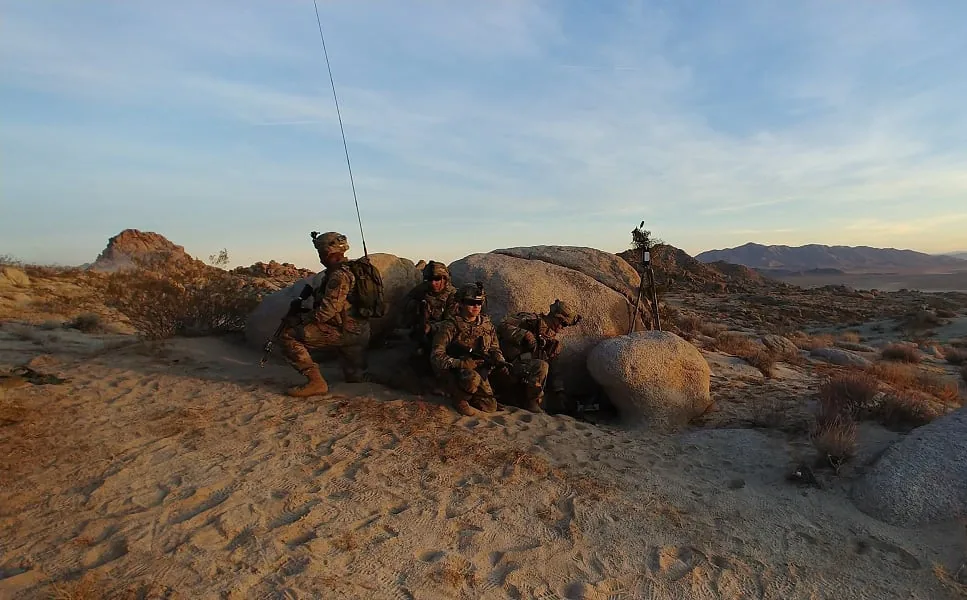
The U.S. Army transitioned its Tactical Intelligence Targeting Access Node (TITAN) program from prototyping to production, awarding a combined $192 million to Palantir Technologies and Anduril Industries. Palantir received $127 million as prime contractor, while Anduril received $65 million to manufacture ruggedized vehicle-mounted systems. The program will produce four advanced and four basic variants for tactical trucks and Joint Light Tactical Vehicles, with delivery over 18 months, supplementing nine existing prototypes.
American Rheinmetall delivered the first Lynx XM30 prototype to the U.S. Army on September 1, 2026, under a roughly $764 million contract to replace the M2 Bradley Fighting Vehicle. The vehicle features a hybrid-electric powertrain and modular open architecture for drone and electronic warfare battlefields. Seven additional prototypes are scheduled for delivery later in 2026, with soldiers conducting combat simulation exercises after safety checks.
The US Army is disbanding its experimental drone battalion in Europe less than a year after its creation in November 2025, which was tasked with learning from Ukrainian drone operations. The battalion will revert to its airborne infantry mission after Exercise Saber Junction in August-September 2026. The decision aligns with Acting Chief of Staff Gen. LaNeve’s “Army Azimuth” roadmap, which prioritizes countering enemy stand-off weapons. Meanwhile, the Pentagon continues expanding drone capabilities, including a new multinational task force by US Central Command.
The U.S. Army awarded Hanwha Defense USA a contract worth up to $262.9 million for up to 18 K9 Mobile Howitzer (K9MH) prototypes under the Mobile Tactical Cannon program. The wheeled 155mm system, derived from the tracked K9, will replace towed M777 howitzers. Six initial prototypes will be tested over four years, with manufacturing planned in Opelika, Alabama. This marks the first time a South Korean firm has secured a U.S. military program for a complete weapons system.
The 9th Brigade Engineer Battalion at Fort Stewart, Georgia, is offering soldiers a four-day pass to play Grand Theft Auto VI if they reenlist by November 14, 2026. Approved by Lt. Col. Ryan Hodgson, the incentive targets younger soldiers amid tighter bonus criteria. As of Monday, 20 of 130 eligible soldiers signed up for two to six additional years. The pass aligns with the game’s November 19 release, highlighting creative retention tactics.
The U.S. Army issued a Sources Sought notice for 133,014 GMLRS rockets by 2034, requiring a 36% production increase over Lockheed Martin’s current capacity. Deliveries begin February 2030, with 19,002 rockets per year from 2028 to 2034. Stockpiles were depleted by deliveries to Ukraine and conflict with Iran, while a shortage of solid rocket motors complicates replenishment. The rockets, used in M270 and HIMARS systems, have been critical in Ukraine’s defense but face reduced effectiveness from Russian GPS jamming.
The U.S. Army selected M1 Support Services for a potential $10 billion, 26-year contract to overhaul helicopter pilot training at Fort Rucker, Alabama, under the Flight School Next program. The contractor-owned, contractor-operated model will use Robinson R66 helicopters to train 800-1,500 pilots annually, replacing the more automated UH-72A Lakota. The shift aims to reduce costs and accidents by emphasizing fundamental flying skills. M1’s team includes Robinson Helicopter, Quantum Helicopters, General Dynamics IT, and the University of North Dakota Aerospace Foundation.
On August 14, 2026, the U.S. Army awarded Airbus Helicopters Inc. a $115.4 million firm-fixed-price contract (potentially $140.7 million with options) for up to 12 UH-72B Lakota light utility helicopters. The upgraded five-blade, Fenestron-equipped variant will serve Army National Guard units in training, medical evacuation, search and rescue, and border security. Deliveries from Columbus, Mississippi, are scheduled between 2027 and 2029, with work at Redstone Arsenal, Alabama, completing by December 2030. The order supports fleet modernization as older UH-72A models are phased out.
On August 12, 2026, an AH-64 Apache helicopter crashed in Salado, Texas, near Fort Hood, killing both crew members. Emergency calls were received at 1:34 p.m. CST, and the victims were pronounced dead at 2:30 p.m. The Bell County Sheriff’s Office confirmed the fatalities, while Fort Hood’s Criminal Investigation Division investigates the cause. Brig. Gen. Ethan Diven expressed condolences and prioritized site security. The crash adds to a series of recent U.S. military aircraft training accidents.
Northrop Grumman announced the Raid Hunter, a palletized 50mm gun-based short-range air defense (SHORAD) system, at the Space and Missile Defense Symposium in Huntsville, Alabama. Designed to counter drone swarms and cruise missiles, it uses precision-guided ammunition and AiON C2 software. The system offers a cost-effective alternative to missile interceptors, addressing economic imbalances highlighted by conflicts in Ukraine and the Middle East. Testing runs through 2026, with an operational prototype targeted by summer 2027.
U.S. soldiers and Marines from the 2nd Infantry Division/ROK-U.S. Combined Division conducted live-fire training with Neros Archer Strike FPV drones armed with C4 explosives at Rodriguez Live Fire Complex in South Korea. This marked the division’s first use of live ordnance with the system, part of a broader military push to equip smaller units with attack drones for strikes up to 20 kilometers away. The drones, tested in real-world conditions in Ukraine, also support surveillance and cargo missions.
The U.S. Army abruptly relieved Lt. Gen. Charles Costanza from command of V Corps in Europe on August 10, 2026, with less than two months left in his tenure. No specific reason was given, but the matter has been referred to authorities. Brig. Gen. John Mountford serves as interim commander, with Maj. Gen. Thomas Feltey nominated for permanent command. Costanza’s removal follows a series of leadership shakeups in U.S. Army Europe, including the early departure of Gen. Christopher Donahue and canceled troop deployments, amid a Pentagon review of force posture in Europe.
ARX Robotics UK successfully deployed eight GEREON unmanned ground vehicles during Project Convergence-Capstone 6, the U.S. Army's largest modernization experiment at Fort Irwin, California, from July 20-29, 2026. The six-day exercise involved forces from the U.S., UK, Australia, Canada, and New Zealand testing over 100 technologies. The UGVs operated 24/7 in extreme desert conditions, performing ISR, electronic warfare, counter-drone, logistics, and casualty evacuation missions. Payloads included L3Harris, MyDefence, and Overview systems. The trial validated allied interoperability and supported the British Army's shift toward autonomous systems.
The U.S. Army has expended virtually all of its ATACMS and PrSM long-range precision missiles, and over half of global Tomahawk cruise missiles, during a five-month war with Iran that began in February 2026 under President Trump. The depletion, driven by a policy to avoid piloted aircraft strikes, has strained defensive systems like Patriot and THAAD interceptors. While the White House claims production is at record levels, analysts warn supplies may be insufficient for a prolonged conflict, raising concerns about U.S. deterrence against Russia and China.
American Rheinmetall secured an 18-month US Army contract under Project Sustainment to develop hybrid-powered autonomous unmanned ground vehicles (UGVs) for frontline resupply, reducing soldier risk in contested areas. The consortium includes Harbinger, Forterra, and Primordial Labs, integrating AI autonomy, voice control, and exportable power. Testing occurs at various US locations, with options for follow-up orders, supporting Army modernization and autonomous logistics.
Sikorsky Aircraft, a Lockheed Martin subsidiary, has been awarded a $56.8 million contract modification (P00002 to W58RGZ-26-C-0008) for advanced procurement funding toward UH-60M Black Hawk helicopters for the US Army, bringing the total contract value to $121.8 million. Work will occur in Stratford, Connecticut, with completion expected by December 31, 2027, funded from fiscal year 2025 Army aircraft procurement budget. The Army Contracting Command at Redstone Arsenal oversees the activity. The UH-60M Black Hawk, in service since 1978, is a medium-lift utility helicopter used for troop transport, supply delivery, search and rescue, and other missions. The article also notes recent international sales: Portugal ordered three Black Hawks, and US authorities approved a potential $1.5 billion Foreign Military Sale of 12 UH-60M helicopters to Austria. Additionally, Sikorsky received a $10.2 million contract for APX-123A Mode 5 retrofit work for Saudi Arabia.
Everforth ECS, a subsidiary of Everforth, has been awarded a $115 million three-year contract by the US Army Combat Capabilities Development Command (DEVCOM) Army Research Laboratory to support the Nautilus for AI Research and Development programme. As prime contractor, Everforth ECS will accelerate the development, testing, and operational integration of advanced AI technologies for the Department of War. The work focuses on trusted AI for Army applications, including methods to transition AI from laboratory settings to operational environments, particularly in contested, bandwidth- and compute-constrained situations. The company will apply expertise in AI development, software engineering, secure systems integration, test and evaluation, and cybersecurity. The goal is to create repeatable and scalable frameworks for moving AI technologies into mission use while meeting security and mission assurance standards. Company executives emphasized the importance of delivering secure AI to support faster, better-informed decisions for service members in demanding operational environments.
The U.S. Army has awarded contracts to Ford, GM Defense, and BC Customs to build competing prototypes of the Infantry Squad Vehicle-Heavy (ISV-H), a six-seat tactical vehicle designed to carry a 4,000-pound payload, tow 6,500 pounds, and export 60 kW of power for counter-drone and directed-energy weapons. Each company will deliver three prototypes by March 30, 2027. The Army plans an initial purchase of 34 vehicles at $463,000 each, with a long-term goal of 606 units to address power-generation gaps at the brigade level.
The US Army tested its Next Generation Command and Control (NGC2) system during Project Capstone Convergence at Fort Irwin, California. The system represents a major overhaul of battlefield command and control, connecting soldiers via laptops, tablets, and radios to share data, manage airspace, and coordinate weapons. While soldiers reported benefits including faster mission planning and improved communication, connectivity issues and integration gaps remain. Some drones and technologies were not yet connected to NGC2, and spotty connections sometimes made elements unusable. Army officials acknowledged challenges but noted unprecedented development speed over the past 9-10 months. The system uses commercial off-the-shelf technology and AI capabilities, with the 4th Infantry Division leading prototyping efforts.
American forces in Kuwait used the US-made Merops counter-drone system to intercept an Iranian Shahed one-way attack drone for the first time in combat, a US official told Business Insider. The system, which consists of a $15,000 interceptor drone capable of speeds over 175 mph and operated via Xbox controllers, has been proven in Ukraine where it downed over 1,000 Russian Shaheds. The US Army deployed Merops to the Middle East in March amid escalating conflict with Iran, which has seen dozens of Iranian missiles and drones intercepted but also resulted in four US service members killed and nearly 100 injured. Several Eastern European nations, including Poland, Romania, and Lithuania, have purchased the system following Russian incursions into NATO airspace. The Army has purchased thousands of interceptors and aims to reduce the unit cost below $10,000.
The US Army has awarded a $117.3 million contract to AeroVironment for 82 P550 electric vertical take-off and landing (eVTOL) uncrewed aerial systems (UAS). The award, under the Army's Uncrewed Aircraft Systems Marketplace initiative, supports the Long Range Reconnaissance program and Battalion Reconnaissance effort. This is the first full-rate order for the P550 platform, which is a Group 2 eVTOL UAS with modular open systems architecture. It can carry multi-sensor payloads up to 15 pounds, operate for up to five hours on battery power, and support missions including ISR, precision strike, electronic warfare, and communications relay. The system can be reconfigured in under five minutes without tools. AeroVironment CEO Wahid Nawabi emphasized the platform's adaptability for contested environments. Earlier in 2025, the company also secured a $186 million order for Switchblade loitering munitions.
The US Army has awarded a $117.3 million contract to AeroVironment for the delivery of 82 P550 electric vertical take-off and landing (eVTOL) uncrewed aerial systems (UAS). The award, issued under the Army's Uncrewed Aircraft Systems Marketplace initiative, supports the Long Range Reconnaissance program and the Battalion Reconnaissance effort. This is the first full-rate order for the P550 platform, which is a Group 2 eVTOL UAS with a modular open systems architecture. The aircraft can carry multi-sensor payloads up to 15 pounds, operate for up to five hours on battery power, and support missions including ISR, precision strike, electronic warfare, and communications relay. The system can be reconfigured in under five minutes without tools. AeroVironment CEO Wahid Nawabi emphasized the platform's adaptability in contested environments. Earlier in 2025, the company also secured a $186 million order for Switchblade loitering munitions.
The US Army has awarded a $117.3 million contract to AeroVironment for the delivery of 82 P550 electric vertical take-off and landing (eVTOL) uncrewed aerial systems (UAS). The award, issued under the Army’s Uncrewed Aircraft Systems Marketplace initiative, supports the service’s Long Range Reconnaissance program and Battalion Reconnaissance effort. This is the first full-rate order for the P550 platform, which is a Group 2 eVTOL UAS featuring a modular open systems architecture. The aircraft can carry multi-sensor payloads up to 15 pounds, operate for up to five hours on battery power, and support missions including ISR, precision strike, electronic warfare, and communications relay. The P550 can be reconfigured in under five minutes without tools. AeroVironment CEO Wahid Nawabi emphasized the system's adaptability in contested environments. Earlier in 2025, the company also secured a $186 million order for Switchblade loitering munitions.
At the Farnborough Airshow, Lockheed Martin announced the PAC-3 ACE (Adapted Capability Effector), a new interceptor for the Patriot air defense system costing roughly half the price of the current PAC-3 MSE (about $2.5 million per missile). Designed to counter aircraft, cruise missiles, and short-range ballistic missiles, it leverages existing Patriot fire control and the Integrated Battle Command System (IBCS). Lockheed plans to collaborate with U.S. and European partners, with initial production possible by 2028, addressing global pressure on Patriot missile stocks.
Anduril Industries, in partnership with Archer Aviation, unveiled the Thunder, a Group 5 autonomous tiltrotor attack drone at the 2026 Farnborough Airshow. Designed as a wingman for crewed helicopters like the Apache, the hybrid-electric aircraft can carry up to ten missiles or 76 rockets. It uses Anduril's Lattice autonomy software for formation flight and aims to triple munitions capacity at reduced cost. First flight is planned for 2027, with potential production by decade's end.
Anduril, a California-based defense firm, announced plans for an autonomous attack tiltrotor named Thunder, just weeks after winning the US Air Force's drone wingman contract. Developed with Archer Aviation, the vertical-takeoff-and-landing rotorcraft is group five-sized, hybrid-electric powered, and designed to fit in a standard shipping container. Company officials say multiple Thunders could accompany each crewed helicopter, such as the Apache, tripling available munitions at a fraction of the cost. Thunder can carry up to ten air-to-ground missiles, 16 launched effects, or 76 70mm rockets. First flight is expected next year, with production potentially starting by the end of the decade. Anduril also aims to attract international customers, debuting the model at the Farnborough air show. Boeing has a similar tiltrotor drone concept.
The US Army's 7th Infantry Division released photos showing soldiers training with the Dark Eagle Long-Range Hypersonic Weapon (LRHW) during Exercise Valiant Shield in June 2026. While the Army did not disclose the location, open-source analyst '笑脸男人' (lfx160219) identified Guam as the likely site based on the photos, the movements of US Pacific Command chief Admiral Samuel J. Paparo, and the exercise's geographic scope. The Dark Eagle system, developed by Lockheed Martin and Northrop Grumman, fires a hypersonic glide body at speeds over Mach 5 with a range of approximately 3,500 km. From Guam, this places mainland China within striking distance. The deployment comes after years of testing delays, with the first operational missiles expected to be delivered to the 3rd Multi-Domain Task Force in fiscal 2026.
The U.S. Navy's program to install hypersonic Conventional Prompt Strike (CPS) missiles on three Zumwalt-class destroyers is two years behind schedule, according to a Government Accountability Office (GAO) report. Missile flight testing has been pushed from 2025 to 2027. The program faces rising costs, with estimates growing from $31 billion for 262 missiles to $41 billion for 224 missiles. Technical challenges include unreliable ship power systems, cabling issues, and production difficulties at Lockheed Martin, including heat-resistant coating problems and insufficient factory capacity (6-7 missiles per year vs. desired 12). The GAO also highlighted a lack of coordination between the Navy and Army on the joint program, with the Army independently studying production increases. The Zumwalt class was reduced from 32 ships to three due to cost and capability concerns.
The U.S. Navy's plan to equip three Zumwalt-class destroyers with hypersonic missiles is two years behind schedule, according to a Government Accountability Office (GAO) report. The Conventional Prompt Strike (CPS) missile program faces rising costs, with estimates ballooning from $31 billion for 262 missiles to $41 billion for 224 missiles. Technical challenges include unreliable ship power systems, excessive cabling removal during modifications, and production issues at Lockheed Martin, where the factory can only produce six or seven missiles annually instead of the desired 12. Additionally, the Navy and Army are not adequately coordinating on the joint CPS program, despite the Army developing a similar land-based version (LRHW). Missile flight testing has been pushed from 2025 to 2027. The Zumwalt class was reduced from 32 ships to three due to cost and capability concerns.
The U.S. Navy's effort to equip three Zumwalt-class destroyers with hypersonic missiles is two years behind schedule, according to a Government Accountability Office (GAO) report. The Conventional Prompt Strike (CPS) missile program faces rising costs, with estimates ballooning from $31 billion for 262 missiles to $41 billion for 224 missiles. Flight testing has been pushed from 2025 to 2027. The GAO also highlighted reliability issues with the Zumwalt-class ships, including power system problems and difficulty obtaining spare parts. Production challenges at Lockheed Martin include heat-resistant coating issues, substandard parts, and insufficient factory capacity (6-7 missiles per year vs. 12 desired). Additionally, the Navy and Army are not adequately coordinating on the joint program, with the Army using its own consultant for production studies. Worker training is also a concern, as complex engineering specifications are given to recent high school or vocational school graduates.
1 reports · 1 sources · Updated
Periodic recap
What changed for this subject in each tracking window — generated from matched events, delta-first.
→· 3 events in window
Following the previous period's training contract overhaul, the U.S. Army saw three new developments. A brigade engineer battalion at Fort Stewart, Georgia, introduced a GTA VI release pass incentive to boost reenlistment amid tighter bonus criteria. On the equipment front, the Army awarded Hanwha Defense a contract to test wheeled K9 mobile howitzers and issued a sources sought notice to significantly ramp up GMLRS rocket production to replenish depleted stockpiles.
The 9th Brigade Engineer Battalion at Fort Stewart, Georgia, is offering a four-day pass to play Grand Theft Auto VI for soldiers who reenlist by November 14, with 20 soldiers signed up as of Monday.
The U.S. Army awarded Hanwha Defense USA a contract worth up to $262.9 million for up to 18 K9 Mobile Howitzer prototypes to replace towed M777 howitzers.
The Army issued a Sources Sought notice for over 133,000 GMLRS rockets by 2034, requiring a 36% production increase from Lockheed Martin to replenish stockpiles depleted by deliveries to Ukraine and conflict with Iran.
Earlier recaps
→· 1 event in window
On August 17, the U.S. Army announced a major training overhaul, awarding M1 Support Services a potential $10 billion, 26-year contract to restructure helicopter pilot training at Fort Rucker, Alabama. The contractor-owned, contractor-operated model will replace the UH-72A Lakota with Robinson R66 helicopters, aiming to reduce costs and accidents by emphasizing fundamental flying skills.
→· 2 events in window
The U.S. Army recorded two events between August 14 and 15, neither directly related to last week's leadership change in Europe. Northrop Grumman unveiled a new 50mm gun-based air defense system intended to offer the Army a lower-cost counter-drone option. Separately, an Apache helicopter crashed near Fort Hood, Texas, killing both crew members; the cause is under investigation.
→· 1 event in window
The U.S. Army abruptly relieved Lt. Gen. Charles Costanza from command of V Corps in Europe on August 10, with less than two months remaining in his tenure. No specific reason was given, but the matter has been referred to authorities. The removal is the latest in a series of leadership shakeups in U.S. Army Europe, occurring amid a Pentagon review of force posture in the region.
→· 1 event in window
Against the backdrop of the missile stockpile crisis, the US Army continues to advance its modernization experiments. During Project Convergence-Capstone 6, ARX Robotics' GEREON unmanned ground vehicles successfully completed multinational joint testing, validating the operational capability of autonomous systems in extreme environments.
→· 1 event in window
Following the previous period's focus on autonomous logistics, a significant shift has emerged. The US Army has nearly exhausted its stockpile of long-range precision strike missiles during the five-month war with Iran, including all ATACMS and PrSM missiles and over half of its Tomahawk cruise missiles. This depletion, driven by a policy of avoiding piloted aircraft strikes, has strained defensive systems like Patriot and THAAD. While the White House claims production is at record levels, analysts warn that supplies may be insufficient for a prolonged conflict, potentially undermining US deterrence against Russia and China.
Tracked events
Events matched to this subject by the tracking pipeline, with signal scores.